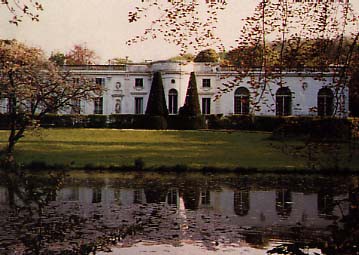
The Petit Malmaison (Little Malmaison) is a private and listed historical
monument, commissioned in 1803 by the Empress Josephine, who desired
to have a space on the Malmaison estate reserved for her passion,
botany. Initially, she called on the landscape architect Jean-Marie
Morel (1728-1810). But he was soon to be replaced by Jean Thomas Thibault
(1757-1826) and Barthélemy Vignon (1762-1846). For the decoration,
she employed renowned artists such as the monumental mason, Gilet,
the bronze-smith, Thomire, and the cabinet-maker, Jacob Desmalter.
Completed in 1805, the building comprised two parts: a large greenhouse,
and a reception building from which to view the greehouse.
The hothouse was designed for growing varieties of exotic
plant and trees, some of which grew as tall as 5 metres.
These rare species, among them the hortensia (Josephine's emblem,
one of her names being Hortense) were brought by
the naturalist, Bonpland. It was here that the botanist, Redouté,
designed some of his most beautiful hybrids for the rose garden.
The greenhouse disappeared on the death of Eugène, the
Empress's son. Today only the central building survives, with its
charming sitting-rooms, converted by Berthault, where Joséphine
received her guests for a cup of tea after a visit of the
greenhouses. The aim of the Czarnecki family, the present owner of the
building, is to preserve this luxurious Empire atmosphere.
The three hectare grounds of Little Malmaison contain
exceptional flora and fauna. There are notably very valuable types of tree,
such as the bald cypresses on the banks of the 'rivière anglaise', a lake
fed by a spring in the Malmaison forest. The garden laid out around the lake
is a precursor of the 19th century romantic garden
with its curves and its studied air of naturalness.
A charming dwelling, whose white facade is reflected in the
bright water of its lake, Little Malmaison is an indispensible
complement to a visit to the Château de Malmaison and the Château de Bois
Préau Museum.
Little Malmaison