This museum of the period in Italy known as
the Risorgimento is dedicated entirely to the chequered history of Italian
unification, a movement in which Napoleon in fact played an important
part. For it was as a result of the First Italian Campaign that Bonaparte
established himself as a defender of the Italian cause against the
Austrian invader, making Milan the capital of the newly created
Cisalpine Republic in 1797, and founding the Kingdom of Italy in
1805, the first Napoleonic state outside France.
Many of the objects in the museum come from this period of French
domination. Indeed, a bust of Napoleon is the first thing visitors
see as they enter the museum courtyard. In this work by Giovan
Battista Comolli, the emperor is represented as the king of Italy,
his head crowned with the Iron crown of Italy and his shoulders
swathed in a toga fixed by a medallion bearing the imperial eagle.
The first room explores the subject of the First Italian Campaign,
exhibiting artefacts related to the main events, notably:
the proclamations and public notices promulgated by Napoleon and
Salicetti; engravings of the battles of Lodi and Arcole; the standard
of the Third Light Artillery regiment; Massena's sword; the first
Italian tricolour handed out to soldiers of the Cisalpine troops
in 1796; etc. A marble bust carved in 1888 by Pietro Fumeo shows
Bonaparte as a young general of the Italian army, and a double
portrait (engraved in Milan “from life”) represents Josephine
next to her husband.
The second room, in its exhibits, presents a much broader time
scale. Here there is a profusion of documents from the Consular period set
side by side with objects relating to the “Hundred Days”, notably: an ink-well used by Napoleon during
his stay on Elba and during the 'Hundred Days'; a pair of his
spurs; a part of his travel library, a sort of box made to
resemble a book which contained his favourite reading; a snuff-box
with a double portrait, in profile, of the emperor and his second
wife Marie-Louise. Italian history of the period is shown in
engravings representing, amongst many other Napoleonic moments,
the Peace celebrated in Milan on 30th April 1801 in the Foro
Buonaparte, and the inauguration of the Italian Republic on
26th January 1802. There are also portraits of the generals
Bonfanti, Lonati, Giuseppe and Teodoro Lechi, the vice-president
of the Italian Republic François Melzi d'Eril, and the Minister
of the Interior, Giuseppe Arburio di Breme (painted by Appiani).
The third room is entirely dedicated to Napoleon's coronation
which took place in the Duomo on 26th May 1805. A bust of
Napoleon dominates the case containing articles
used in the ceremony: the sceptre with the lion of St Mark
(chosen as a symbol of Italian bravery); the hand of justice;
the crown; the grand seal of the Kingdom of Italy; and a plaque
recording the status of Grand Dignitary of the Royal Order of
the Iron Crown. There are in addition portraits engraved by
Bosio of Josephine, Eugène, viceroy of Italy, and his wife
Marie-Amelie, as well as engravings by Rosaspina showing
allegories of Napoleon and the coronation. In the next room
there is the magnificent green velvet cloak, embroidered with
gold and sliver, which was worn by the emperor for his coronation
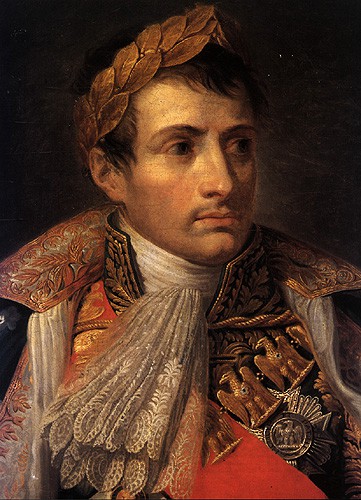
in Italy. Nearby hangs the portrait by Appiani of Napoleon in his
imperial finery with a laurel crown on his head. The other two
cases in this room contain medallions and miniatures record
later history, notably that of the King of Rome.
The Second Empire also has a privileged place in the
museum. Many of the rooms follow the theme of
Napoleon III and his decisive role in the problem of Italian
unity in the period from the Crimean War to the Treaty of
Zurich in 1859. The Italian Campaign of 1859 is represented
for the most part graphically, with pictures of the battles of
Magenta (Induno), and Solferino (E. Pagliano). Objects along the
museum route are: a bust of Napoleon III; a statue of Vittorio-
Emmanuele II in French Zouave uniform; a statuette of MacMahon,
Duke of Magenta; medallions containing portraits of the emperor,
the empress, Vittorio-Emmanuele, Cavour, Garibaldi, the Duchess
of Castiglione. Uniforms, arms, engravings and the enormous
painting “Milan on the announcement of the Peace of Villafranca”
complete the ensemble. There are also items referring to
Garibaldi's 'Mille', as well as some of the famed 'red shirts'.
Museo del Risorgimento – Milan