

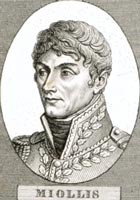
Fact file
Born Aix en Provence, 18 September, 1759, died Aix en Provence, 18 June, 1828
Married Rosalie Boutté, Nice, 1798
Seriously wounded fighting under Rochambeau at Yorktown, 1781, during the American War of Independence
Rose from the rank of lieutenant en 2e (1782) to lieutenant colonel en 1e (1792) in the 3e bataillion des volontaires des Bouches-du-Rhône
Appointed General de Brigade in the Armée d'Italie in 1794
Fought in Italy in 1796-97 (distinguishing himself at Finale (1795), Faubourg-St-Georges (1797))
Governor of Mantua, 4 February 1797
Distinguished himself in the Tuscan Campaign, December 1798, fighting with success under Gouvion Saint-Cyr at Recco (end of August 1799) and Rapallo (14 October 1799)
Made Général de Division, 19 October, 1799
Involved in the fall of Genova, 1800
Deprived of his commission in 1802 as a result of his voting against the Consulat à vie
After going to Saint-Cloud to petition Napoleon in person he was recalled to the ranks, becoming again Governor of Mantua, 28 August, 1805
Erected two commemorative columns, one in Mantua to Virgil and the other in Ferrara to Ariosto
Made commander of all French troops stationed in Italy, October 1805
Occupied Venice under Eugène de Beauharnais, December 1805
Chevalier, and later commandeur, of the Couronne de Fer, June 1807
Took Rome and became commander of the Division de Rome, February 1808
Grand Officier de la Légion d'honneur, 14 September, 1808
Comte de l'Empire, 16 September, 1808
Commander of the Order of the Two Sicilies, 25 November, 1808
Ordered the arrest of Pius VII, 6 July, 1808
Commanded the 30th division in Rome (1810) until the convention agreed between Murat and Fouché forced him to leave, 10 March, 1814
Chevalier de St-Louis, 13 August, 1814
Called to present himself to Louis XVIII, Miollis was ordered to become commander of the military district of Bouche-du-Rhône and Vaucluse under Masséna, January 1815
Sent by Masséna to intercept the Emperor landing at Golf Juan, 7 March 1815
Arrived at Gap to learn that Napoleon had reached Grenoble three days earlier, and subsequently returned to Marseilles ‘as Masséna had ordered'.
During the Hundred Days made governor of Metz by Napoleon, April 1815
Retired by Louis XVIII, 25 August, 1815, on full pension
Spent the last years of his life between Paris, Isle-Adam, Villefranche, and Aix
Died hitting his head on the corner of a marble tabletop during a fall.
Member of a noble family from Aix, but supported the Revolution. He however voted against a Consulat à vie for Bonaparte, which resulted in his immediate removal from the army. In his most remarkable action – his arrest of the Pope – he would appear to have been acting without Napoleon's instructions. Much of his active life was spent in Italy.
Further reading
Auréas, H., Général de Napoléon: Miollis, Paris: Les Belles Lettres, 1961