 |
|
 |
|
|
ARTICLES
Marengo and the Pyramid
(Article by
HICKS Peter
)
Bibliographical details
Introduction
Preview of the collection
Partnership
The Museum
The collection (1)
The collection (cont.)
|
Introduction
|
|

|
 |
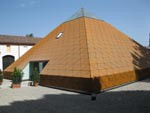
In May this year, Napoleon finally got his pyramid in commemoration of the Battle of Marengo, 14 June, 1800. The pyramid was built and financed by the Provincia di Alessandria in a project piloted by the president of the Provincia di Alessandria, Paolo Filippi, the president of the Centro Studi Napoleonici, Giulio Massobrio, and Cultural Services manager Gigi Poggio. And the inauguration of the new pyramidal entrance space took place on the weekend of 23-24 May, 2009.
|
|
Preview of the collection
|
|

|
 |
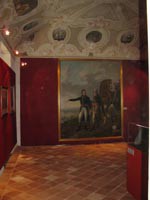
The new museum auditorium was packed to hear speeches by the Paolo Filippi, Peter Hicks of the Fondation Napoléon, the Assessore di Cultura, Maria Rita Rossa, and Giulio Massobrio, joint project manager with Gigi Poggio for the new Marengo Museum. Visitors were then given a preview of the permanent collection and several prestigious loans, notably the Fondation Napoléon's massive canvas of Napoleon and Berthier at the Battle of Marengo and some remarkable military memorabilia loaned by an anonymous local collector.
|
|
Partnership
|
|

|
 |
The Fondation Napoléon has signed a partnership with the Provincia di Alessandria which envisages scholarly and museological collaboration. Articles produced by the Centre for Napoleonic studies in Alessandria will be published in Napoleonica La Revue (the Fondation's e-journal), the Fondation will act in an advisory capacity on the scientific committee for the designing of the new Museum of the Battle of Marengo, or Marengo Museum. The re-opening of the museum and the building of the pyramid is part of the Fondation's commitment to encourage and support the study of Napoleon I worldwide.
|
|
The Museum
|
|

|
 |
The building of the pyramid is just the start of a complete refurbishment and re-creation of the museum on the battlefield. An international committee has been appointed to plan a 21st-century museum, using modern techniques to chart the history of the idea of the Battle of Marengo. The museum as it stand today has not only multimedia exhibits but also a modern study annex including office space, a large auditorium suitable for conferences, and space for temporary exhibitions.
|
|
The collection (1)
|
The museum is currently divided up into thirteen rooms: 1 – The Battle of Marengo, 14 June, 1800 This room contains visual elements related to the depiction of victory at Marengo, in other words, sketches, paintings, and even a cadastral plan. 2 – The representation of the myth The two main pieces in this room are a "demonstrative plan" of the battle by Pietro Buzzo and Alphonse Lalauze's dramatic 1910 painting (a recent acquisition funded by the Fondazione Cassa di Risparmio di Alessandria) showing "Gunner Barailler defending his cannon". 3 – From the myth to the legend This rooms is an evocation of the two images of Napoleon – the young general of the army of Italy, the victor at Lodi and Marengo (characterised by the music of the Marseillaise) and the mighty emperor, ruler of the continent (marked by the music of the Hymn to victory). 4 – The Marengo pyramid In this room, a short documentary film recounts the history of the Marengo pyramid. There are furthermore reproductions of period architectural sketches of the planned pyramid currently held in Paris at the SHD. 5 – The Glory This section is surround-sound installation based on the view seen through a kaleidoscope centred on the Arc de Triomphe and playing around the idea of glory using images expressing the Napoleonic legend. 6 – Delavo and the Napoleonic legend This section of the museum traces the building of the villa in which the museum stands by Antonio Delavo and his plans to create a park, museum and Marengo "sanctuary". 7 – The dream of perfection: spheres and pyramids This room is another son et lumière presentation, this time of the idealistic architectural projects of the late 18th-century, characterised by Boullée's tomb for Newton, into which tradition the building of the pyramid is to be set.
|
|
The collection (cont.)
|
|

|
 |
8 – The sites This room presents images of sites of the conflicts during the period 1796-1800 in the wider area around Alessandria and Marengo, including notably one of the (later destroyed) fortress of Tortona. 9 – The restoration of Villa Delavo, 1966-68 This room is dedicated to the restoration of the exceedingly dilapidated villa in the late 1960s. It includes photographs of the famous carriage used by Napoleon in 1805, which once belonged to the museum but which is now in private hands. 10 – The large model of the battle 11 – The museum in 1989 In addition to the large model of the battle in room 10, three further models (illustrating key moments in the battle of Marengo) can be seen here in room 11. These were made and placed here in 1989. They show the Austrian troops crossing the Bormida on the morning of the battle, the combat on the Fontanone canal, and the meeting between Bonaparte and Desaix at San Giuliano. Also here is a model of the hamlet of Marengo as it was when the battle took place. 12 – Current alterations This room is dedicated to the restoration performed on the villa after the earthquake of 2003. 13 - The future The multi-media installation in this room is a taste of how the museum may look in the future.
|
|
|
|
|
|
|
|
|
|