

The occupation of Spain by Napoleon's troops beginning in 1808 and the patriotic reaction which ensued inspired Goya to one of his most dramatically forceful works. His very famous paintings Dos de Mayo and Tres de Mayo, which testify to the violent uprisings which took place in Madrid on 2 May 1808 and the terrible repression on 3 May, remain in the whole of the history of art two of the most powerful statements against the horrors of war . They were painted “in order to preserve with the brush the most remarkable and heroic actions… of our glorious insurrection against the tyrant of Europe”, was how Goya put it. These two works were both produced in 1814, after the depature of king Joseph and the French troops.
And yet, already in 1808, Goya was expressing his revolt against the attrocities which he had seen and testifying to it by means of his many works showing not only the brutality of the Napoleonic soldiers but also the vicious exactions committed in the name of resistance. It was at this time that he made a series of small paintings which he kept for himself in his atelier showing scenes of brigandage, pillage, massacres, rapes and torture, eloquent denunciations of the bestiality of human nature. And then in 1810 he made a seris of 82 engravings, showing the disasters of war, which the painter called “The fatal consequences of the bloody war waged in Spain against Bonaparte, and other forceful fantasies”.
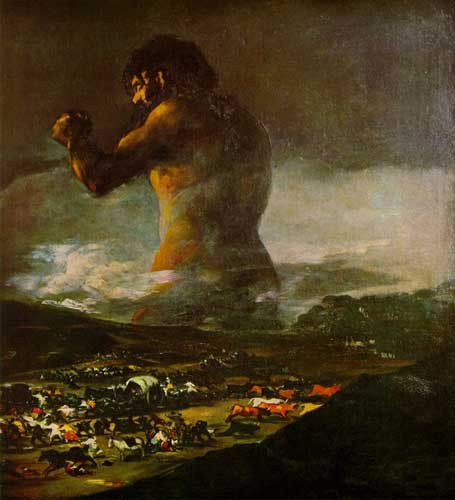
The Colossus, begun 1808, is part of this series of works. The meaning of the painting however remains unclear, and contradictory hypotheses have been put forward. For some, this terrifying giant towering over the horizon is the symbol of war which drives men and animals to flee, the incarnation of Napoleon himself. For others, it is not that but rather the guardian spirit of Spain against the invader, or rather the people becoming conscious of its own power.
Whatever the meaning may be, Goya here presents us with a vision of world falling apart. We see the inner conflict tormenting Goya. As a supporter of the enlightenment and revolutionary ideals, Goya, like many Spaniards saw Napoleon as the saviour who would deliver Spain from the decadent and corrupt Bourbon monarchy. The saviour became the oppressor. Torn between his liberal convictions and patriotism, Goya here reveals his torment in this sombre work.
Karine Huguenaud (tr. P.H.)
The attribution of this painting to Goya has recently been disputed. So much so that the Prado exhibition has removed the work from its bicentenary exhibition. Read some articles on the question here.
February 2002
The Colossus
Artist(s) : GOYA y Lucientes (Francisco de)
- Date :
- 1808 - 1812
- Technique :
- oil on canvas
- Dimensions :
- H = 1.16 m, L = 1.05 m
- Place held :
- Madrid, Prado Museum