

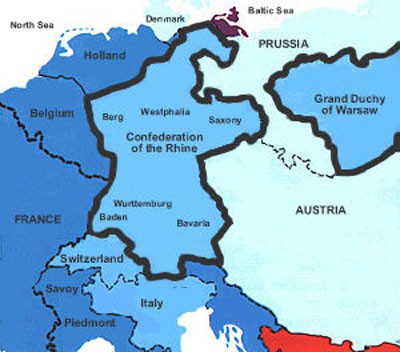
On 16 July, 1806, a treaty was signed in Paris bringing about the creation of the Confederation of the Rhine or Rheinbund.
The treaty was ratified by Napoleon and the members on 19 of the same month.
The confederation was a group of sixteen German states under the presidency of a Prince primat, helped by a coadjutor, the whole under the protectorate of Napoleon. The first Prince primat was Carl Theodor von Dalberg (1744-1817), civilian governor of Erfurt in 1772, bishop of Constanz in 1800, Prince-Archbishop of Mainz in 1802 and as a result of this title Archchancellor elector of the Holy Roman Empire. His seat of office was transferred From Mainz to Regensberg, the city in which he died in 1817. His coadjuteur was Cardinal Fesch, Napoleon’s uncle.
Napoleon I became the protector of the confederation and had the power to nominate the Prince primat’s successor on the latter’s death. The Protector did not intervene in the internal affairs of the confederation. These were managed by the Federal diet. The rulers enjoyed full sovereignty over theior respective territories (that is, they were free from the interference of Prussia or Austria).
The treaty also had an alliance clause «by virtue of which any continental war undertaken by any one of the signatories of the treaty would immediately become a common struggle for all the other members». Napoleon, in his role as protector, garrisoned (at the host’s expense) more than 200,000 men in the various states, whilst each member state of the Confederation promised to provide Napoleon with a military contingent totalling 63,000 men.
Visit our special dossier for the bicentenary of the creation of the Confederation of the Rhine on napoleon.org