-
Introduction
Halfway between Picardy and Paris
Compiègne is a key monument for all First and Second Empire enthusiasts. Its remarkable setting in the heart of the Oise valley, on the edge of a vast forest renowned for its hunting, is the explaination as to why it held a special place in the hearts of all the kings of France. Indeed, it was rather this excellent hunting, and not the fact that the town was a key point in the lines of communication, which over the centuries led to the area becoming one of the principal royal residences. The 18th-century courtier, the Comte de Chevergny, described Louis XV’s infatuation with the place in the following words: ‘Hunting was his main passion […] And Compiègne, with its immense forest, with its endless avenues amongst the trees, with its stretches down which you could ride all day and never come to the end, was the ideal place to indulge that passion’. Madame Adélaïde, the King’s daughter poured praise upon ‘charming Compiègne’ which she ‘simply adored’.
What is more, Compiègne was the preferred summer residence for the monarchs of France – Louis XIV alone stayed there 75 times – and it soon became a traditional stopping point during coronation ceremonies on the return from Rheims. And although the palace suffered during the Revolution, it was to return to its glory under the Empire when it was transformed into an imperial residence which rivaled both Versailles and Fontainebleau. Just like Napoleon I, Napoleon III too fell under its spell. Indeed Compiègne was to see its swan song during the Second Empire, when it became the official residence of imperial court during the autumn and the stage on which contemporary society was to appear in its entirety during the famous ‘Series’. Nor has this cultural and natural heritage been abandoned. Today the town can be visited in many different ways. The present itinerary however takes you on an exclusively imperial journey.
The museums and sites marked in hypertext (that is, which are underlined) take the reader to a detailed file. The headings at the top of the page are to facilitate the organisation of your stay and they provide: an interactive map, practical information, information on where to stay and eat, information on other sites of interest in the region and finally a short bibliography. To follow this itinerary in its entirety, you should set aside a long weekend.
Karine Huguenaud
(October 1996)
-
Route : Our itinerary begins in the heart of old Compiègne in front of the Hôtel de Ville
The architecture of this fine edifice – built at the end of the 15th century during the reign of Louis XII – marks the transition period between Late Gothic and the beginnings of the Renaissance. Viollet-le-Duc, who restored it in the 19th century, described it as the ‘best example of civil architecture in the whole of the north of France’. In the belfry hangs the ‘Bancloque’, one of the oldest known bells anywhere, dated 1303. At the top of the ‘Bancloque’, three automata – a German, an Englishman and a Burgundian, dressed in 16th-century costume – strike the bell with their hammers, marking the hours for the town. During the Revolution, all the statues on the façade were destroyed. In 1869, a bronze statue of Louis XII on horseback was reinstalled in the central niche. Flanked by effigies of Charles VII and Joan of Arc, this statue of Louis stands above statues of Saint-Denis, Saint-Louis, Cardinal Pierre d’Ailly and Charlemagne. The two adjacent pavilions were built in 1660 and 1867 respectively. As for the interior, on the walls of the town council chamber hang nine paintings by Fournier-Salovèze which record the great historical events of the town. Indeed one of these events is also commemorated by a statue in the square in front of the town hall. The statue is of Joan of Arc and it recalls the attempted defence of the town in 1430 when that ‘Maid of Orleans’ was captured and handed over to the English.
The first stop in this itinerary
The first stop in this itinerary is the Museum of Historical Figurines. This is housed in an annex to the right of the Hôtel de Ville, in what was once the Hotel de la Cloche et de la Bouteille where Alexandre Dumas stayed in 1836. Indeed a scene from The Count of Monte-Cristo is set there. The museum was founded as a result of the bequest of the collection of Alfred Ternisien and it provides a panoramic view of the military history of France, from Antiquity to the Second World War. There are in total about 100,000 figurines from the 18th, 19th and 20th centuries, and they are all arranged in dioramas. The Napoleonic period has a special place in the museum, most notably with an astounding reconstruction of the Battle of Waterloo. Indeed, this museum is the perfect beginning to the voyage of discovery of the town of Compiègne and its history.
On leaving the Place de l’Hôtel de Ville
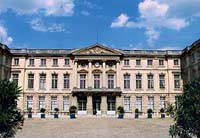
On leaving the Place de l’Hôtel de Ville, turn right into the Rue des Patissiers then take Rue des Minimes to Place du Général de Gaulle (previously the Place d’Armes). Here stands the sober Classical façade of the Château de Compiègne. The building as it stands today represents the final state of a series of royal residences stretching right back to that of Clovis. What was originally a simple wooden Merovingian villa, perfect as a hunting lodge, had become by the 5th and 6th centuries a ‘compendium palatium’ or palace, as several charters attest. The Royal palace at Compiègne grew in importance under the Carolingians and the town and surroundings also began to develop. Charles the Bald, in the middle of the 9th century, made Compiègne his official seat of office from which he wielded first royal and later imperial authority. In the 14th century, Charles V had a new building constructed upon the site of the present château. This architectural ensemble, enlarged, modified and transformed, was to serve as a residence for the kings of France up until the middle of the 19th century. As a stopping point during the ceremonial of coronations, as a hunting reserve, as halt on the road north, Compiègne is the only other royal dwelling, along with Versailles and Fontainebleau, to have had the privilege of being the seat of government. Indeed, until as late as 1847, military camps were pitched in the forest. However, lack of space meant that courtiers were forced to lodge in the town or in nearby châteaux. In 1750, Ange-Jacques Gabriel proposed a reconstruction plan which was immediately accepted and enacted – and finally finished by Gabriel’s pupil, Le Dreux de La Châtre in 1776. The triangular plan of the château was dictated by the site, itself delimited by the ancient ramparts of the town. The distinguishing features of both the interior and exterior are simplicity, rigour and clarity.
During the French Revolution, the royal palace of Compiègne passed under the jurisdiction of the Minister for the Interior, whose task it was to liquidate all assets. In 1795, all the château’s furniture ensembles were sold and the works of art were sent to the Muséum Central. 1799 and 1800 saw the setting up of the ‘Prytanée militaire’ and Bonaparte’s first visit. He visited again in 1803 and was able to see at firsthand the damage caused by the introduction of the Ecole des Arts et Métiers. The place became a ‘domaine impérial’ in 1804, and in 1807 Napoleon, while in Finkenstein, ordered that the residence should be made inhabitable. The architects Berthault, Percier and Fontaine, the decorators Dubois and Redouté and the cabinet makers Jacob-Desmalter and Marcion formed the team charged with bringing the palace back to its former royal glory. The room distribution was altered, a ballroom was built, and the garden was replanted and linked directly to the forest. In a conscious attempt to re-associate Compiègne with its royal past, it was there in 1810 that Marie-Louise was received by her husband to be, just as Marie-Antoinette had been 40 years earlier. Similarly, in 1814, on his return from exile, it was here that Louis XVIII was received by Napoleon’s marshals.
The First Empire left indelible marks on the decoration of the château
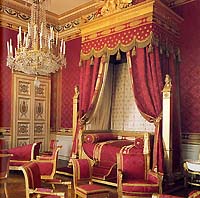 ‘Compiègne speaks of Napoleon as Versailles does of Louis XIV’ as Auguste Luchet, the temporary ‘gouverneur’ of the palace in 1848, was fond of saying. Indeed he suggested that the château be turned into an imperial museum. Whilst some of the surviving décor dates back to Louis XVI and Marie-Antoinette, the Empire style dominates. In fact, Compiègne is the only imperial residence which still has today its décor and furniture of 1808-1810. Generally speaking, the restoration of the July Monarchy had little effect upon the aspect of the palace, and the arrangement of the rooms and the furniture within them were to remain essentially those of the late Empire. Only the Napoleonic emblems were removed. On the other hand, some of the furniture and the decoration in some rooms were changed during the Second Empire. The ‘historical apartments’ are notably: the King’s, and subsequently Emperor’s, apartment; the Empress’s apartment; the Queen’s, and subsequently King of Rome’s, apartment; and the Dauphin and Madame Royale’s, and subsequently the Prince’s, double apartment. The rooms in each apartment have been carefully restored, paying great attention to historical accuracy.
The Second Empire was for the chateau of Compiègne a return to the glories of the past
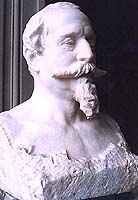 From 1856 on, Napoleon III and Eugénie made it their autumn residence and began their famous ‘Series’. For about a month and a half (usually from the end of October to the beginning of December), hundreds of guests (ferried to Compiègne on special trains from Gare du Nord) were received every week by the royal couple. The political, artistic and scientific elite of the Second Empire all passed through the doors of Compiègne, where they were treated to entertainments of various types. The Musée du Second Empire is a collection of vivid reminders of this brilliant epoch. This museum, installed in what used to be the Marshals apartments, was created in 1953 and comprises collections of painting, sculpture, furniture and objets d’art. It is not so much a panorama of contemporary art as a selection of major artists of the period, notably Carpeaux, Couture, Meissonier, Winterhalter, Boudin and Daumier. And official portraits, historical and military scenes, works by the different manufactories and objects presented at the Universal Exhibitions all go to recreate the atmosphere of the reign.
The musée de l’Impératrice is an indispensable complement to the Second Empire museum
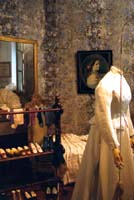 As a collection of items which once belonged to the Imperial Family, it shows the private side of Napoleon and Eugénie’s lives from their marriage up to the tragic death of the Prince Impérial in 1879. Indeed the museum is particularly touching with its exhibits connected with the heir to the throne’s education, the sovereigns’ charity work, their visit to the provinces or abroad, their life in exile and the Prince Impérial’s fatal journey to South Africa.
The third and final museum
The third and final museum housed in the Château de Compiègne is the Musée de la Voiture et du Tourisme, created in 1927 on the initiative of the Touring club de France. It retraces the history of locomotion and the horse-drawn vehicle from their origins (with the taming of horses) to the first automobiles. And amongst the carriages in this remarkable collection, there is notably the berline in which Bonaparte made his entry into Bologna in 1796, and the completely upholstered, Compagnie du Nord, imperial train carriage used by Napoleon III.
On leaving the château’s right-hand exit, follow Rue d’Ulm to the Imperial Theatre
This theatre, although commissioned by Napoleon III was not inaugurated until … 1991! With the defeat at Sedan and the fall of the Second Empire, work stopped and a part of the decoration was never completed. The theatre itself, linked to the palace by a covered gallery in the form of a bridge, was based on the Opéra de Versailles and has an excellent acoustic. The Théâtre français de la Musique performs operas and concerts there every year. On leaving the theatre, retrace your steps and follow the château walls as far as the entrance to the park.
Ange-Jacques Gabriel had drawn up plans for a ‘French’ garden between the château and the forest in his reconstruction project
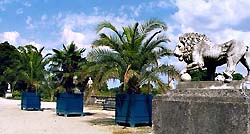 Ange-Jacques Gabriel had drawn up plans for a ‘French’ garden between the château and the forest in his reconstruction project. But left incomplete at the beginning of the Revolution, the garden suffered badly at the hands of the Prytanée militaire. In 1808, Napoleon ordered that it should be reorganised, starting with the building of a gentle slope up the apartments on the terrace to allow the passage of carriages. In 1811, Berthault presented plans for an ‘English’ garden. An awning was built across the whole length of the façade so as to protect the apartments from the sun, three pavilions were erected (‘for resting in’), and a system of arched trellises was constructed ‘to make its possible to get, under cover and in the shade, from the château to the forest. Finally, a large park was made, linking the garden to the forest.
This extra park which lengthened the garden …
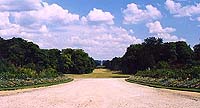 This extra park which lengthened the garden made it possible to design a new avenue which led from the terrace of the château (following the axis of the Allée Napoléon) to the top of a nearby hill, Beaux-Monts, four and a half kilometres away. This giant axis, somewhat Schoenbrunn-esque in its appearance, linked and unified the garden, park and forest. Work was continued during the Restoration and Berthault was to complete his garden with the addition of several other features, notably: a rose garden, the ‘Cours du Pistolet’, a ‘triangle de “tous les diables”‘, and a temperate greenhouse. The sculptures in the grounds were not added until during the period from 1822 to 1830, and the work was not completed until the Second Empire. There are about thirty statues, of which some are in the antique style and were brought from the Tuileries and the Louvre. During the Second Empire, various divertissements were set up in the garden for those invited to the ‘Series’, most notably a carrousel. In 1862, the greenhouse was transformed by Napoleon III into a Gallo-Roman museum.
The Forêt domaniale de Compiègne
The Forêt domaniale de Compiègne (Compiègne Forest), of which the park is simply a prolongation, has always been excellently maintained because of the fascination it held for the hunting-obsessed royalty of France. In fact, it stands next to the forêt de Laigue and the forêt d’Ourscamps and was originally part of the ancient forêt de Cuise, which belonged to the kings of the Franks. It is shot through with magnificent avenues and as such is ideal for horse riding – indeed it has always been rich is big game and was the preferred site for hunting and coursing. The principal tree species are oak, beech and hornbeam. The forest covers 15,000 hectares of land and contains almost 35 kilometres of cyclable tracks and 1,000 kilometres of pathways punctuated by 273 crossroads. Each crossroads has an evocative name mounted on an elegant post, on which there is also a red pointer indicating the direction of Compiègne. These avenues, originally made for the hunt, have made Compiègne forest a walker’s delight.
The itinerary now continues by car (or bicycle!)
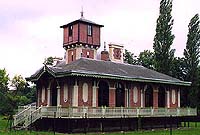 … through the forest. Take the Route Eugénie which connects Compiègne to Pierrefonds, passing via Vieux Moulin, a charming forest village at the foot of the hill, Mont-St-Marc, with its many Second Empire houses. The hunts nearly always began here: only the invitees with ‘the button’ could participate – the rest had to follow in the carts. During the Second Empire the hunts would finish in the courtyard with a terrible spectacle, the ‘curée aux flambeaux’. Follow this road to the ‘Etangs de Saint-Pierre’, near to which stands what used to be the Empress Eugénie’s hunting lodge. Built in 1861, this building contains two fireplaces monogrammed with the Napoleonic ‘N’ and a tapestry bearing a hunting scene.
Finally, at the end of the Route Eugénie, looms the evocative
… du Château de Pierrefonds, a superb example of military architecture, restored by the architect Viollet-le-Duc to a glory which even at its zenith it had never known. The original castle was built in the 15th century by Louis d’Orléans, only to be taken down in the 17th century. It was literally recreated in the middle of the 19th century by the Gothic revival genius, Viollet-le-Duc, and in his ‘restoration’ he revealed the extent of his abilities. The Emperor’s and Empress’s apartments still today show his innovative decorative solutions. Every time the imperial couple stayed at Compiègne they would come to visit the ruins and to see how the work was coming on. Most of those invited to the ‘Series’ were brought along too. With its remarkable archeological accuracy and its extraordinary inventiveness, Pierrefonds provides a fitting closing flourish to this imperial itinerary.
-
Continuations
The National Compiègne Stud Farm
Almost right next door to the palace, the buildings forming this stud farm were, in the 17th and 18th centuries, the royal and subsequently imperial stables. Louis XV commissioned them in 1738. These stables, comprising two buildings arranged in an L-shape, could house 96 horses. There were in addition two pavilions, one for the Master of the King’s Horses and another for the stable lads. Napoleon I had the stable enlarged but they were not to find their complete fulfillment until the Second Empire when they were used by the Imperial Hunt. The site has been a stud farm since 1876 and is today open to the public.
Haras national de Compiègne
1, bd Victor Hugo 60200 Compiègne
Tel.: +33 (0)3 44 38 54 50
The Gallo-Roman site at Champlieu
Napoleon III, a keen archeologist, started the dig here and came regularly to see how things were progressing. Today all that remains of this Gallo-Roman site uncovered during the Second Empire are the remains of temples, a theatre and some baths, all dating from the 2nd century AD. The town of Compiègne is preparing a large exhibition planned for October 2000 entitled ‘Napoleon III and archeology’.
The Sainte-Périne Lake
In the heart of the forest of Compiègne lies a lake which was dug in 1813 near to the hamlet of La Brévière. A 13th-century chapel stands nearby.
The Maison Gallé-Juillet in Creil
This residence, built in 1780 on the remains of an older château, presents to the public an ensemble of 19th-century furniture, arranged on two floors of the house, showing the lifestyle of the provincial middle classes in the 19th century. Most of the items are from the Restoration and the Second Empire periods. Visitors are presented with paintings, objets d’art, toys, clothing, illustrations of scene from Balzac or Flaubert, and most notably a large collection of china from Creil and Creil-Montereau.
Musée de Creil – Maison Gallé-Juillet
Cours du Château 60100 Creil
Tel.: +33 (0)3 44 29 51 50
The Condé Museum in Chantilly
This remarkable collection of French and international painting (14th to 19th century) is well worth a visit. First of all for its setting: the Petit-Château dating from the 16th century and the Grand-Chateau built between 1875 and 1882 for the Duc d’Aumale and the splendid park designed by Le Nôtre. And second, for the paintings in the ground-floor gallery of the Grand-Château. Here, the works are arranged irrespective of the school or period; Poussin hangs next to Veronese, Champaigne, Nattier, de Troy, Lancret, Gérard and Delacroix. Further in, rooms entitled ‘La Rotonde’ and ‘Le Sanctuaire’ house masterpieces by Raphael, Filippino Lippi and the magnificent Heures d’Etienne Chevalier by Jean Fouquet. Aumale’s eclecticism however reaches its climax in ‘Le Tribune’, where Watteau hangs next to Perugino and the portrait of Gaston d’Orléans forms an ensemble with that of Bonaparte by Gérard, and where Fra Angelico, Botticelli, Sassetta and Poussin are set alongside a fine ensemble of works by Ingres, namely L’autoportrait à vingt-quatre ans, Madame Devcauçay, and his Vénus Anadyomène. Nor are pictures on Napoleonic themes lacking. To mention Les Cuirassiers en 1805 and Avant la charge by Meissonier, a study for Gros’s Pestiférés de Jaffa, and Les Grenadiers à cheval à Eylau by Detaille, is to name but a few. In addition to this prestigious collection should be added the famous Chantilly stables which today house the Living Horse Museum.
Musée Condé – Château de Chantilly
60200 Chantilly
Tel.: +33 (0)3 44 62 62 62
The Senlis Hunting Museum
Housed in what used to be the Priory of Saint-Maurice, this museum tells the history of hunting and coursing from the 15th century to the present day. Indeed hunting was a royal and aristocratic passion and hence was the source of many interesting artistic commissions. As a result the museum owns a good many fine quality works of art, notably engravings by Stefano della Bella and Jacques Callot, paintings by Jean Sauvé, Jacques Fouquières and Paul de Vos, not forgetting well-known works by Desportes and Oudry. In the 19th century, Carle and Horace Vernet were outstanding illustrators of the art of hunting and the museum has some fine paintings by them, as well as watercolours by Eugène Lami and works by Dedreux, Rosa Bonheur, Princeteau, Lepaulle, Boldini, Blanche, Hallo and Trémois. There is also an interesting display of hunting accoutrements, notably hunting clothes, liveries, arms, hunting horns and bugles, giving the visitor a good idea of what exactly happened during a hunt.
Musée de la Vénerie
Château Royal 60300 Senlis
Tel.: +33 (0)3 44 53 00 80
National Gallery of Tapestry and Textile art
This national gallery, which stands very close to the cathedral, has a remarkable collection of tapestries of all styles dating from the 15th right up to the 20th century. The works all come from the French national furniture collection, the Mobilier national. The Manufactory, founded in 1664, is open to visitors on Tuesdays, Wednesdays and Thursday afternoons.
Rue Saint-Pierre
60000 Beauvais
Tel.: +33 (0)3 44 05 14 28 -
Curiosity corner
In Compiègne
Compiègne has not only been a royal town and the seat of an imperial power and its palace, it is also an old city full of charm, with winding streets and half-timbered houses, affording delightful strolls.
On leaving the Hôtel de Ville, the Rue Saint-Corneille leads directly to the abbey of the same name, built on the site of the Merovingian palace. The Abbaye Notre Dame, which was to become Abbaye Saint-Corneille, was consecrated in 877 by Charles the Bald, who attempted to turn Compiègne into a second Aachen. In fact the Saint-Corneille Abbey played an important role for the monarchs of the Middle Ages. Many of them were crowned or buried there – the last to be laid to rest here was Henri III whose body (after his assassination) was to remain there for 21 years. All that remains of the Benedictine monastery today is the cloister and surrounding buildings dating from the 14th century and the remains of the 12th century south bell tower.
Continue down the Rue Saint-Corneille to Rue Jeanne d’Arc. At the end of the latter road stands the Hôtel Dieu Saint-Nicolas. This medieval hospital, founded by Philippe Auguste and rebuilt by Saint-Louis, contains a chapter house with carved wooden decoration and painting, and a chapel with a splendid Baroque sculpted wooden reredos. The building is however only open during exhibitions. Facing the hospital is the Tour Jeanne d’Arc (also known as the Tour Beauregard and the Grosse tour du Roi), the remains of a 12th-century royal keep. It formed part of the defences for the old bridge over the Oise. The first arches of this bridge can still be seen on the opposite bank of the river at the end of Rue Jeanne d’Arc.
Crossing the river into Rue d’Austerlitz brings you to the Musée Vivenel. Constructed in 1801, the building houses a remarkable collection of antiquities from the region, as well as an exceptional display of Greek vases. There are also Egyptian and regional antiquities, ivories, bronzes, and Flemish, French and Italian paintings. In fact the Greek vases come from the collection of Antoine Vivenel, an entrepreneur who helped in the building of the Paris Hôtel de Ville, and it is the largest collection of such items outside the Louvre. The museum is situated next to the Songeons park in which stand the arcades of the cloister of a Jacobin convent. (Musée Antoine Vivenel, 2, rue d’Austerlitz 60200 Compiègne tel.: +33 (0)3 44 20 26 04)
Go back up the Rue Austerlitz to the Eglise Saint-Antoine, built in the 13th and 17th centuries. The typically Renaissance porch, choir and ambulatory are interesting, but they are surpassed by the chevet with it apse and the smaller apses and their openwork balustrades. The Tournai stone fonts date from the 13th century and come from the Saint Corneille abbey. Of particular interest is a statue of the Virgin by Caffieri dated 1775.
Walking down the Rue Saint-Antoine and going beyond the Place au Change, you come to the very fine Neoclassical façade of the Salt Store, situated at the very beginning of Rue des Lombards. This rusticated portal with pediment was built by Claude Nicolas Ledoux in 1784 and at one time it formed the entrance to the Salt Store – the salt tax, the Gabelle, was one of the most hated. Today the store is a fish market. Continuing up the Rue des Lombards, at number 10 stands the Vieille Cassine, the oldest half-timbered house in Compiègne. This typically 15th-century house was once the residence of the Bridge Masters, that is, the boatmen.
Go on down this road as far as the Rue des Cordeliers and turn left where you will see the Eglise Saint-Jacques. This ancient royal parish church, made wealthy by gifts from Louis XV in 1765, was founded during the reign of Saint-Louis. It possesses some remarkable architecture, notably the openwork clerestorey and the balustrade of the choir which once surrounded the bed of Louis XVI at the palace of Compiègne. A side chapel houses the relics from the Saint-Corneille abbey, most notably a piece of the Virgin’s veil. The bell tower has a lantern which was added in the 17th century. On 18 May 1430, Joan of Arc came to pray in Saint-Jacques and she returned again on 23 May, the day of her arrest.
Continue on towards the château and turn right onto the Rue des Minimes. Off to one side on the left stands Saint-Pierre des Minimes, the oldest church in Compiègne, dating from the 12th century. Deconsecrated many years ago, the building has been much rebuilt, however vestiges of coloured decoration in the pediment can still be seen. The building is soon to be used as exhibition space for temporary exhibitions.
Outside this circuit which goes round the centre of the town, the streets Rue de Vermonton and Rue de Fossés, Compiègne’s ancient city walls (12th to 17th centuries), have been converted into a very pleasant walk.
In the Surroundings
Musée de la clairière de l’Armistice
(Museum of the Armistice clearing)
Near to the village of Rethondes, in a train carriage parked in a clearing about 6km from Compiègne, Maréchal Foch dictated to the defeated Germans the text of the Armistice of 11 November 1918. In June 1940, Hitler parodied this ceremony on the same site. Although the actual wagon used for both ceremonies was destroyed in 1944, an identical model has been built and set here as a museum. On display are stereoscopic views of the 14-18 war and some of the actual furniture used for the signing of the Armistice.
Clairière de l’Armistice
60200 Compiègne
Tel.: +33 (0)3 44 85 14 18Saint -Jean-aux-Bois
This village set in the middle of the forest is still surrounded by its fortified walls and there are even two sixteenth century gates. The church belonging to the Benedictine abbey, founded in the 13th century, is fine Gothic. Saint-Jean-aux-Bois also boasts the oldest tree in the forest, an oak 900 years old.Morienval
This small settlement on the edge of the forest has a beautiful Romanesque church, dating from the 11th and 12th centuries, with three bell towers.
Musée national de la Coopération franco-américaine du Château de Blérancourt
(The Château de Blérancourt national museum of Franco-American cooperation)
Built in 1612 by Salomon de Brosse, the four pavilions of the château have been arranged in themes around the different personalities who have worked for Franco-American cooperation in the period from the 18th to the 20th centuries. The modern, Florence Gould pavilion presents a collection of paintings and sculptures by American and French artists of the 19th and 20th centuries. The gardens, with their ensemble of flowers and shrubs from the world over, are superb.Château de Blérancourt
02300 Chauny
Tel.: +33 (0)3 23 39 60 16
-
Bibliography
Find out more about
On the château, the museums and the park
Marie-Blanche d’Arneville, Parcs et jardins sous le Premier Empire, Paris, Tallandier, 1981
Trois siècles d’art des jardins au château de Compiègne, catalogue of the exhibition organised by ” L’atelier au château “, DRAC Info Picardie, n°26, sept-oct. 1986
Jean-Marie Moulin, Le château de Compiègne, RMN, 1989.
Jean-Marie Moulin, ” L’appartement du roi de Rome et l’appartement de Prince: problèmes de restitution des états historiques “, La Revue du Louvre et des musées de France, Vol. 39, n°1, 1989, p. 70-79
Jean-Marie Moulin, Le Château de Compiègne : son histoire, sa constitution, Paris : RMN, 1991.
Jean-Marie Moulin, Guide du musée national du château de Compiègne, RMN, 1992.
Collectif, Compiègne, numéro spécial Connaissance des Arts, 1991.
” Vers une restitution des états historiques : la politique exemplaire de Compiègne “, L’Estampille -L’objet d’art, 294, septembre 1995, p. 4-5
Pierre Clapot et Françoise Teynac, Théâtres de châteaux, Editions du Mécène, 1996.
Jacques Kuhnmunch et Françoise Maison, Le goût d’un amateur au Premier Empire : peintures hollandaises et flamandes, Paris : RMN, 1995
Brigitte Ducrot, Porcelaines et terres de Sèvres au musée national de Compiègne, RMN, 1993.
Christian Lapointe, Musée de la figurine historique, Compiègne : Association des Amis du Musée Vivenel et de la Figurine Historique, 1985.
Bernard Thaon, Pierrefonds ou l’impossible jardin, Paris : Nouvelles éditions latines, 1987.
Robert Dulau, Le Château de Pierrefonds. Oise, Editions du patrimoine, CNMHS, 1997.The town and the forest
Bulletin de la Société Historique de Compiègne (depuis 1878)
J. Cl. Malsy, Compiègne, le château, la forêt, Paris : Nouvelles Editions Latines.
Jean-Pierre Gilson, Compiègne en sa forêt, preface by Jean Favier, Plon, 1998.
Top 25, Carte des forêts de Compiègne et de Laigue, (1/25 000), IGN, 1995.
Collectif, Oise 1 / 150 000 (Carte départementale), Michelin, Cartes et plans.
Marie-France Healer, Circuits pédestres T55 : pays d’Oise, Franck Mercier, 1996.
Dominique Auzias, Le Petit Futé : Compiègne 1999-2000, City Guides, 1999.Life in Compiègne during the First and Second Empires
Jean Dumont, “Les aménagements du Palais de Compiègne sous le Premier Empire“, Revue du Souvenir napoléonien, n°300, p.4-6
Paul Ganière, “Marie-Louise et Napoléon à Compiègne“, Revue du Souvenir napoléonien, n°300, p. 7-16
Jean-Marie Moulin, “La Cour à Compiègne sous le Second Empire“, Revue du Souvenir napoléonien, n°300, p. 17-23
Th. René-Lafarge, L’Impératrice Eugénie et ses femmes, chapitre XII ” Les ‘séries’ de Compiègne “, Hachette, 1938
Frédéric Loliée, Les grandes dames de Compiègne sous le Second Empire, Paris : Jules Tallandier.
Pierre de Lano, Les bals travestis et les tableaux vivants sous le Second Empire, 25 watercolour plates, sd.
Adolphe de la Rue, Les chasses du Second Empire, Collection Les Grands Maîtres de la Chasse et de la vénerie V, Paris : Pygmalion, 1984. -
Map
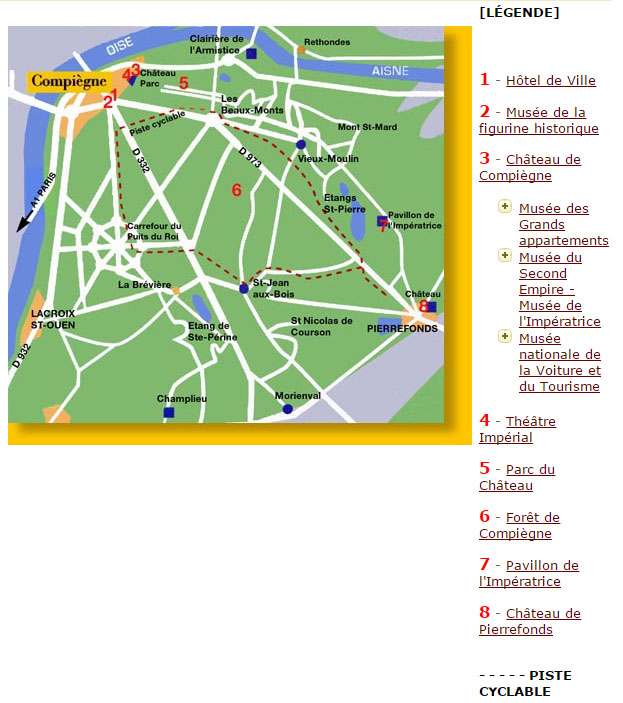
-
Practical information
Access
By car:
From Paris: motorways A3, and then A1: exit 9 Chevrières or 10 Arsy
From Lille: motorway A1: exit 10 Arsy
N31 (Rouen – Rheims) 35 mn Roissy/Charles de Gaulle AirportBy plane: Roissy/Charles de Gaulle Airport nearby
By train: TGV – Roissy to Paris
Direct line from SNCF Gare du Nord à Paris – Compiègne – Amsterdam – Cologne. Every day there are 19 Paris-Compiègne trains, 10 of which do the journey in less than 52 minutes.Tourist Information Office
Place de l’Hôtel-de-Ville
B.P. 9 – 60321 CompiègneCedex
Tel.: +33 (0)3 44 40 01 00 – Fax: +33 (0)3 44 40 23 28
Group service: +33 (0)3 44 40 03 76
Minitel: 36.15 COMPIEGNE Tourisme
Internet (in French): http://www.mairie-compiegne.fr
Guided tours led by French Ministry of Culture guides:
Rendez-vous 3-30pm on Saturday, Sunday and public holidays at the Tourist Information
Museums
Museum of Historical Figurines
28, place de l’Hôtel de Ville
60200, Compiègne
Tel.: +33 (0)3 44 40 72 55
Open from 9am to Midday and from 2pm to 6pm, from March to October
Open from 9am to Midday and from 2pm to 5pm, from November to February.
Closed Mondays and Sunday morningsMusée national du Château de Compiègne
* the historic apartments
* Musée du Second Empire – musée de l’Impératrice
* Musée de la voiture et du tourisme
Place du Général de Gaulle
BP 10769 – 60207 Compiègne Cedex 2
Tel.: +33 (0)3 44 38 47 00; fax +33 (0)3 44 38 47 01
Obligatory bookings for groups: +33 (0)3 44 38 47 02
Open every day from 10am to 6pm except Tuesdays
From 1 November to 28 February, the major apartments will be open from 10am to 3-45pmGuided tours: the major apartments and the Musée de la Voiture et du Tourisme
Talk/visits from September to March at 11am and 3pm:
– History, décor and furniture
– Napoleon I and Marie-Louise
– The King of Rome and Compiègne
– Napoleon III and Eugénie
Talk/visits on specific themes from September to March at 3pm.
The park is open from 8am to 5pm in winter and from 7-30am to 8pm in summer.Imperial Theatre
Association pour le Théâtre de Compiègne
3, rue Othenin 60200 Compiègne
Tel.: +33 (0)3 44 40 17 10
Fax: +33 (0)3 44 40 44 04
Performance bookings (numéro vert): 0800 03 13 46Château de Pierrefonds
60 350 Pierrefonds
Tel.: +33 (0)3 44 42 72 72
Fax: +33 (0)3 44 42 36 59
Open every day except 1 January, 1 May, 11 November and 25 December.
March, April, September, October: 10am-12-30pm; 2pm-6pm. Sundays and public holidays: 10am-6pm
May, June, July, August: 10am-6pm
November, December, January, February: 10am-12-30pm; 2pm-5pm; 10am-5-30pm on SundaysPavillon de chasse de l’Impératrice Eugénie
Etangs de Saint-Pierre
Forêt de Compiègne
Visit permitted only by prior appointment with Office National des Forêts: +33 (0)3 44 40 02 75.Supporting Associations
The Musées nationaux du château de Compiègne have three associations which assist in the development and life of the château’s collections, namely:
La société des amis du château de Compiègne
Château de Compiègne BP 10769 – 60207 Compiègne Cedex 2
Tel.: +33 (0)3.44.38.47.02La société des amis du Musée national de la voiture et du tourisme
Château de Compiègne BP 10769 – 60207 Compiègne Cedex 2
Tel.: +33 (0)3.44.38.47.00L’Association européenne pour les théâtres de cour et théâtres privés
Château de Compiègne BP 10769 – 60207 Compiègne Cedex 2
Tel.: +33 (0)3.44.38.47.02
Carriage rides, horse riding, mountain biking, boating and walking
CARRIAGE RIDES/HORSE RIDING
Imperial carriage rides
All rides leave from the entrance to the parc du château, with a choice of three routes:
1 – Visit with commentary to the parc historique du château de Compiègne (30 mn)
2 – Visit with commentary to the major monuments in Compiègne (30 mn)
3 – Guided visits with qualified tour guides:
– the historic apartments and the park visited by carriage (2h)
– The Musée national de la voiture et du tourisme and the parc visited by carriage (2h)
– The Musée national de la voiture et du tourisme, departure from the park by carriage and visit to the stud farm (2h)
– The park seen by carriage (1h)
From 17 April to to October, every weekend and public holiday; every day in July and August. Every day from April to October (groups only, reserve in advance). Route 3 is available every day except Tuesdays and public holidays (+33 (0)3 44 38 47 02)
For information, consult the Tourist Information Office and the Ecuries de la Chaussée (Mr Cassez +33 (0)1 64 36 65 42)Haras national (National stud farm)
1, bd Victor-Hugo 60200 Compiègne
Open every day from 2pm to 5pm
Tel.: +33 (0)3 44 38 54 50Horse riding
Comité départemental de tourisme équestre
Tel.: +33 (0)3 44 51 22 84Vieux-Moulin Riding School
Tel.: +33 (0)3 44 85 62 87BIKING
Cyclable tracks – Bike hire
Flat 35km circuit of cyclable tracks through the forest from Compiègne to Pierrefonds and passing via Saint-Jean-aux-Bois. 200 models of bike available (from ‘gondola’ bikes to mountain bikes) for hire from Chez Picardie Forêts vertes (+33 (0)3 44 90 05 05 or +33 (0)6 07 54 99 26) or from AB cyclette (+33 (0)6 85 08 12 80)BOATING
Boat trips on the Oise and the Aisne
From April to end of October. Trips available ranging from 1h30, to 1/2 day or full day with meal on board or in a hotel. Boats pick up and set down at Compiègne, Cours Guynemer. Call the Tourist Information Office to book.WALKING
Discover Compiègne forest on foot with an official Office National des Forêts guided tour, from May to October. Themes include: ‘In the foosteps of the Empress Eugènie: The forest around the étangs de Saint-Pierre’; ‘Night walks: a new sensation’; ‘His majesty the stag, a twilight watch’, etc.
Information and bookings: +33 (0)3 44 40 02 75
Compiègne
From one empire to the other, the château and forest of Compiègne were the backdrop for the most remarkable pomp and ceremony. Napoleon I and Marie-Louise, Napoleon III and Eugénie, two imperial couples, one imperial palace.