|
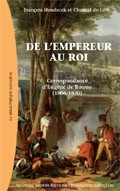
HOUDECEK François, DE LOTH Chantal, De l'empereur au roi. Correspondance d'Eugène de Roussy (1806-1830) (in French)

|
© Nouveau Monde Editions
|
 |
Description: From the publishers: This publication gathers together 159 previously-unseen personal letters covering the period 1806 to 1830 to trace the career of Eugène de Roussy. A young nobleman from the mountainous Cévennes area in France, de Roussy took part in many of the major campaigns of the First Empire, including Friedland, Wagram and Borodino. Through accounts that put a greater emphasis on military exercises, daily life in the army, and the training of conscripts than on heroic charges, these letters place the reader at the very heart of the Grande Armée. During the Cent-Jours, de Roussy turned his back on Napoleon and rallied to Louis XVIII's call. Stationed with the royalists forces in the Midi, he was involved in the unrest that broke out in the Gard département during the summer of 1815. Post-Napoleon until 1830, he served at his sovereign's side as a member of the Royal Guard. During the July Revolution, he accompanied Charles X as the latter fled to Cherbourg: his account of this journey remains poignantly honest. These letters offer a veritable snapshot of imperial society, one in which the nobility of the Ancien Régime found itself caught between rallying to the cause and playing the waiting game. The publication features an introductory preface from Emmanuel de Waresquiel, author of numerous books on Napoleonic history, including Les Cent-Jours ou la tentation de l'impossible.
An expert in the military and social history of the First Empire, François Houdecek works at the Fondation Napoléon as project manager for the publication of the General Correspondence of Napoleon Bonaparte. Chantal de Loth, a descendent of Eugène de Roussy, is fascinated by the study of private and family archives. Contents: - Preface - Introduction - Preliminary note - Aux gendarmes d'ordonnance 1806-1807 - Au 28e régiment de dragons 1808-1811 - De Paris à Cherbourg Été 1830 - Annexes - Sources and bibliography - Acknowledgements - Index
Place and publisher: Paris: Nouveau Monde Editions/Fondation Napoléon
Date of publication: 2012
|
|
This week’s book(s):
Description: From the publishers: In The Barbed Crown, the sixth tale of rogue and adventurer Ethan Gage by William Dietrich, our hero returns to Paris and London. Against a background of imperial pomp and the gathering clouds of war, Gage plots revenge on Napoleon Bonaparte for the kidnap of his son. Paris, the “City of Lights,” shines – but alongside its splendor is great squalor. Heroic patriotism rubs against mean ambition, while grand strategy and back-alley conspiracy are never far apart. While Ethan spies on the French court, his wife, Astiza, works to sabotage Napoleon's coronation using the Crown of Thorns, a legendary relic said to have come from the Crucifixion itself. But when Napoleon is crowned nonetheless, they flee to England. At Walmer Castle on the English coast, Gage joins a daring campaign by Smith, Fulton, rocket inventor William Congreve and smuggler Tom Johnstone to halt Napoleon's intended invasion of England – a campaign which leads Ethan to take a role in the Battle of Trafalgar itself...
Place and publisher: Harper
Date of publication: 2013
Number of pages: 373
Description: From the publishers: In the wake of French expansion around 1800, large areas were made Départements of the Republic. These areas became increasingly influenced by French revolutionary reforms. This volume examines the characteristics of Napoleonic hegemony in these areas, from conquest to the integration, considering these central aspects: land and politics; society and war; economics and the environment; representation and legacy. The geographic spectrum extends from the Rhineland to Switzerland, Piedmont, Liguria and Rome and Southern Italy. Contents: GUIDO BRAUN, GABRIELE B. CLEMENS, LUTZ KLINKHAMMER, ALEXANDER KOLLERNapoleonische Expansionspolitik: zu den ambivalenten Auswirkungen von Eroberung und Integration p.1 STUART WOOLF Napoleon: politics of integration? p. 18 THIERRY LENTZ Neue Ideologie und grundlegende Konstanten in der europäischen Diplomatie des Napoleonischen Zeitalters p. 27 MICHAEL BROERS Transformation and Discontinuity from the old order to the modern state in the Piedmontese and Ligurian Départments of Napoleonic Italy p . 41 JOHN A. DAVIS Napoleon and Naples: the Imperial Project in Mediterranean Perspectives p. 53 GABRIELE B. CLEMENS Napoleonische Transformationen der Nachbarstaaten. Die rheinischen Départements und die Schweiz p. 63 MASSIMO CATTANEO Das napoleonische Rom (1809–1814). Konsensstrategien und Verweigerungshaltung p. 83 ALEXANDER GRAB Conscription and Desertion in France and Italy under Napoleon p. 102 LUTZ KLINKHAMMER Kontrolle und Identität. Die Grenzen der Freiheit im Rheinland und in Piemont unter französischer Herrschaft p. 120 VOLKER SELLIN Der napoleonische Staatskult p. 138 HANS-PETER ULLMAN Territoriales Finanzwesen, französische Raubwirtschaft und napoleonisches Finanzsystem im linksrheinischen Deutschland p. 160 WOLFRAM SIEMANN Der Umgang mit Umwelt und Natur in der napoleonischen Ära p. 172 HEINZ-GERHARD HAUPT Zur Reichweite napoleonischer Gewerbepolitik. Die Zünfte in den annektierten Gebieten p. 193 COSTANZA D'ELIA Napoleonische Herrschaft in Bild und Text p. 205 ROLF REICHARDT Napoleon der „Weltfresser“? Die europäische Karriere eines anti-revolutionären Bildmotivs p. 241 LUIGI MASCILLI MIGLIORINI Eine Geschichte der zweiten Dimension. An den Wurzeln der Napoleon-Biographie p. 271
Place and publisher: Berlin: De Gruyter
Date of publication: 2013
Number of pages: 286

See all books highlighted as This month's book
|