

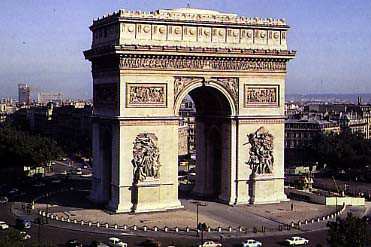
In 1806, Napoleon ordered the construction of a triumphal arch to glorify the Grand Army, and the first stone was laid on 6 August of the same year. Over 160 feet high, it outshone by far all of its predecessors. Designed after the Arch of Titus in Rome, it was meant to provide a majestic close to the prospect of the Champs Elysées.
Chalgrin and Raymond, the two architects on the project, soon disagreed as to whether or not they should include columns. Fontaine, whom the Emperor consulted for advice, believed the columns to be unnecessary as they could not be seen from a distance: “In such an awesome spot, the monument has to be huge” he noted. By an imperial decree passed on 27 March, 1809, it was Chalgrin who won the day and the official project became his.
In 1810, Napoleon and his new wife Marie-Louise entered Paris passing underneath a full-size model of the intended arch made of wood and painted cloth and built on the foundations of the future arch. The fall of the Empire in 1815 brought the construction work to a standstill. Building was resumed in 1824 and the arch was finished in 1830 and opened on 29 July, 1836. It did not however receive its official consecration until 15 December, 1840, when the hearse bearing Napoleon’s corpse passed underneath the arch.
On 2 December, 1852, it was Napoleon III’s turn to ride under the monumental archway. Queen Victoria did the same in 1855 when she attended the reception given in her honour for the Universal Exhibition of that year. More dramatically, the arch became a campsite for the Prussian troops after the defeat of Sedan and the fall of the Empire.
The series of sculptures the arch was to bear was defined after the 1830 Revolution. The pedestals were decorated with four allegorical high-reliefs: two facing the Tuileries, “The Triumph of Napoleon” by Cortot and the extraordinary “Departure of the Volunteers in 1792” by Rude; and two facing Neuilly, works by Etex symbolizing the Resistance and Peace of 1814. Above these reliefs but below the entablature are “Marceau’s funeral”, “The Battle of Aboukir”, “Crossing of the Arcole bridge” and “The Capture of Alexandria”. Above the small, side arches are “The Battle of Austerlitz” and “The Battle of Jemmapes”. Sculptures by Pradier, “The Renowned”, decorate the spandrels of the great arch with subtle harmony, while “The Infantry” and “The Cavalry” are incorporated into those of the small arches. The frieze of the entablature bears a bas-relief 157 metres long featuring “The Departure and the Return of the French Armies”. In 1835, it was decided that the Roman-style coffered vault would be be engraved with the names of 128 battles fought during the Republic and the Empire and those of all the generals who took part in them. Six hundred sixty names thus figure on these walls.
A museum inside the arch details the history of its construction and recalls the important events that took place there.
Karine Huguenaud
Trans. P.H.