

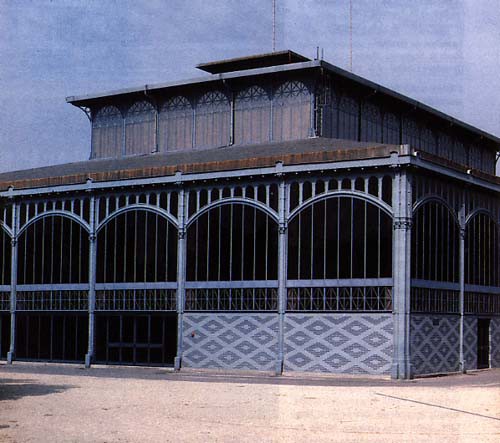
In the town of Nogent-sur-Marne stand the last remains of the Grandes Halles de Paris, Paris's great covered market known as Les Halles and built during the Second Empire. Only as a result of the town's obstinacy was this pavilion the only one to escape demolition in 1970. The Baltard Pavilion (Pavilion number 8) for egg and poultry merchants was dismantled in 1972, rebuilt in Nogent-sur-Marne in 1976, and opened the following year. Transformed into a multi-purpose, cultural space, it constitutes today the major architectural attraction of the town and provides a vivid reminder of the exceptional popularity, in the 19th century, of covered markets.
In 1842, the Count of Rambuteau, prefect of the Seine under Louis-Philippe, commissioned a study for a central market in Paris. In 1845, he asked for a detailed design project from the architects Baltard and Callet, and in 1853 this resulted in the building of a metal structure with a stone shell. The Parisians quickly named it the “Market Fort” because of its solidity. This building was unfortunately poorly ventilated and difficult to access, and so Napoleon III had the building destroyed and launched a competition for a completely different design. “It is vast umbrellas that I need, nothing more” declared the Emperor to Haussmann while sketching with pencil the general silhouette of the building. Baltard won the competition with his proposition for a collection of pavilions entirely composed of iron and glass and thus very well illuminated. The definitive pavilions for the east section were built over the period 1854 to 1858, and those for the west section were constructed between 1860 and 1874. A celebration of metal architecture, Baltard's market bears witness to the emperor's modernist ideas and his fight against the academism in force at the Ecole des Beaux Arts (School of Fine Arts). The transfer of the business side of the market from the centre of Paris to Rungis took place 1969. There was great debate as to what to do with the Parisian site. Despite of the offer of purchase proposed by an American banker, a petition, a press campaign in France and abroad, the intervention of numerous personalities and demonstrations against the destruction of the buildings, demolition began on August 2, 1970. Apart from Zola's novel describing Les Halles, the Baltard Pavilion in Nogent-sur-Marne is all that remains of what was once the “stomach of Paris”. The Pavilion however has been adapted in order to respond to its new role as a place for cultural activities: blue mosaic panels reproduce the old brick-work, the façades have been closed in with tinted glass, a heating system has been installed, the new roof has been thermally insulated, sound and light controls have been added, and a mezzanine and moveable cinema/video screens have been included. This prestigious place of French heritage is now a site for exhibitions, concerts, seminars and conferences. Trans. P.H.