

Created during the Empire, the Bois de Boulogne was a milestone
for garden and park construction in the French capital. In fact it
marked the starting point, in 1852, of the policy of the development
of the green spaces in Paris. And the instigator of the project was
Napoleon III himself. The emperor took an interest in all the squares,
parks and gardens created or re-designed under his orders, but he was
particularly fond of the Bois de Boulogne, a project which he considered
as his personal creation.
On the 17th July 1852 Napoleon named Hittorff as “architect of the Bois
de Boulogne and of the future Avenue de l'Impératrice” (present-day
Avenue Foch). Assisted by Varé the landscape gardener of the Saint-Leu
and Mortefontaine parks, Hittorff decided on a design which followed
the existing topography. But the emperor imposed his addition of a river
like the Serpentine in Hyde Park, a feature of Hyde Park which he had
greatly admired when he was in London. But Varé in his digging of the
mile-wide gully, miscalculated the levels: the river continually
emptied itself at the southern end and flooded the land at the
northern tip. Haussmann (who in the meantime had been promoted
to Prefect of the Seine) sacked Hittorff and Varé and brought
in Alphand and the garden expert Barillet-Deschamps. Keeping
only two of the originally planned straight avenues (the Longchamp
and Reine-Marguerite avenues), the design team made a “English”
landscape with winding paths, stretches of water, streams for
transferring the water from one level to another and rockeries.
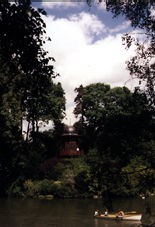
Out of Varé's impossible river, two lakes with two islands were
created, and onto them they transferred an authentic Swiss chalet
(the present-day restaurant the Chalet des Isles), a chalet which
had been built near Berne by Seiler, and they constructed the
charming little “kiosque de l'Empereur”, designed by Davioud.
By expropriating the Longchamp and Bagatelle plains in 1855,
Haussmann extended the Bois de Boulogne down to the river
Seine. The château de Bagatelle and its magnificent garden
were restored and other gardens, such as the Jardin d'acclimatation,
the Jardin du Pré Catalan, and the horse race track, the hippodrome,
were built, making the site very popular with high society.
Considered a sophisticated location, the Bois de Boulogne became
a rendezvous of elegance and scandal. People would come either on
horseback or in a carriage to promenade around the lakes for one
or two hours before returning to their Parisian residences via the
prestigious Avenue de l'Impératrice.
Discover more about the Bois de Boulogne and the other
green spaces provided for Paris by the Second Empire. Take
a wander around our itinerary “Parks and Gardens: Parisians strolls of the Second Empire”.
Bois de Boulogne
Trans. P.H.