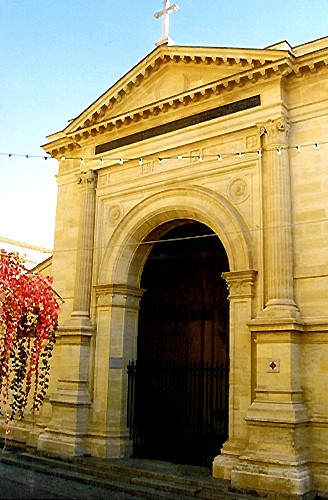
The construction of the Palatine chapel, more commonly known as the 'Imperial Chapel', was the result of the last wishes of Cardinal Fesch: 'On the sale of my Great Gallery of paintings, my heirs should take the sum of two hundred thousand francs for the construction of a church in Ajaccio…in which should be built my tomb, that of my sister Letizia and that of any of the members of the Bonaparte family who wish to be buried there'. After his death in Rome in 1839, Cardinal Fesch was buried in the cemetery in Corneto in Italy next to his sister. In 1857, his wishes were finally granted thanks to Napoleon III who had the chapel built by Paccard, the official architect of the Imperial regime. The chapel was designed on a rectangular plan set in a Latin cross. The construction was built Saint Florent stone on the right wing of Palais Fesch. Consecrated 9 September 1860, the chapel was visited by Napoleon III and the Empress Eugénie on the following day. On the pediment there is a Latin inscription which translated reads: 'To Maria-Letizia, mother of the Emperor Napoleon I, and to Cardinal Fesch who, before he died, instituted for himself, his excellent sister and for her children, this sepulchre, built by Napoleon III'.
The interior of the chapel, most notably the dome, is entirely decorated with floral motifs, figures of priestly objects all done in grisaille by Jerôme Maglioli, and architect and painter in Ajaccio.The stained-glass windows are similarly interesting from an iconographical point of view. Marked with the Fresch 'F', they present compositions combining the ecclesiatical symbols of the cardinalate with the traditional imperial symbols of the eable and the cross of the Légion d'Honneur. The central pillars bear black marble plaques, three of which with inscriptions written in Latin by Champollion-Figeac in memory of Madame Mère, Cardinal Fesch and Charles Lucien Bonaparte, prince of Canbino, Lucien's elder son. The altar, specially prepared during the annual 15 August and 5 May celebrations (the birth and death dates of the Emperor), has mounted above it a Coptic cross which Napoleon offered to his mother on his return from Egypt in August 1799.
The side corridors lead to the crypt which provides the last resting place for the imperial family. On either side of the entrance are the tombs of Princess Clémentine (Laeken 1872-Nice 1955) and her husband Prince Victor (Paris 1862-Brussels 1926). Their son Prince Napoleon (Brussels 1914-Prangins 1997) lies over the door in-between. As for the crypt itself, it is circular and situated exactly in line underneath the dome. In the crypt there are six catafalques dressed in black stone, each marked the a gold engraved name. To the right on entering are: Napoleon's parents, Maria-Letizia Ramolino (Ajaccio 1750-Rome 1836) and Charles-Marie Bonaparte (Ajaccio 1746-Montpellier 1785) whose mortal remains were brought from Saint-Leu-la-Forêt in 1951; following round to the right Napoleon-Charles Bonaparte (Rome 1839-1899), Charles-Lucien Bonaparte (Paris 1803-1857), the princesses Zenaïde (Rome 1860-1862) and Eugénie (Grotta Ferrata 1872-Paris 1949) and finally Cardinal Fesch (Ajaccio 1763-Rome 1939).
Imperial chapel – Ajaccio