
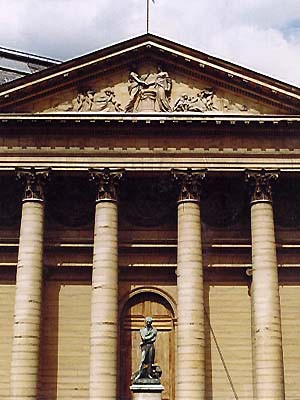
The neoclassical Collège et Académie de Chirurgie (College and Academy of Surgery) by the architect Gondoin was built in the old Rue des Cordeliers over the years 1769-1775. The rival establishment, the Faculté de Médecine, stood on the Rue de la Bûcherie. After the suppression of the academies and the closure of the faculties in 1793, it became clear that there was an urgent need for the medical schools to be reformed and then re-opened. Antoine Fourcroy presented a bill to the Convention and this was ratified on 4 December 1794. Three medical schools were founded, one in Paris, one in Montpellier and one in Strasbourg. The school was housed in the ex-Collège de Chirurgie and was known successively as the Ecole centrale de Santé, the Ecole de Médicine before ending up as the Faculté de Médicine in 1808.
The oldest part of the building is still visible: a colonnade of Ionic columns runs down the side of Rue de l'Ecole de Médicine, fronting a courtyard surrounded by a Corinthian portico, behind which is the the great lecture theatre. This vast building was rebuilt and enlarged in the year 1878-1900 by Ginain and today it houses the main administrative building of the Université René Descartes Paris V, the university library, the Medical faculty's archives and the museum of the history of medicine. This museum, opened in 1954, presents a chronological and thematic view of the history of medicine and surgery from antiquity up to the present day.
The collection contains about 1500 historical medical instruments. The period covering the end of the 18th century and the beginning of the 19th are represented by cases of trepanning instruments, some French medical bags found on the field of Waterloo and some surgeon's instrument cases. There is on display a marble bust by Chaudet (executed by Cartellier) of Antoine-François Fourcroy (1755-1809). Fourcroy's law, which aimed principally at producing 'Elèves de la Patrie' (Pupils of the Fatherland), that is, doctors and surgeons for the military, put a great deal of emphasis on clinical teaching and set down new principals: the fusion of surgery and medicine (it being recognised that the two were merely different aspects of the same branch of study); the development of practical, hands-on teaching ('Read little, do much and see all' was Fourcroy's motto); selection by competition of pupils and teachers; the establishment of a diploma valid throughout France. This new approach based on the rational practice of medecine was to be broadly illustrated by Corvisart (1755-1821), the professor of internal clinical medecine who was nominated Medecin du Gouvernment by Bonaparte in 1801 before becoming Doctor to the Emperor after Napoleon's coronation.
The museum has two exceptional pieces. The first and most remarkable is the doctor's case belonging to Antommarchi who had used it for the autopsy of Napoleon on St Helena (the case was given to the head of the faculty, Orfila, in 1837). The other is a model body made by Felice Fontana for use in anatomy lectures. In 1796, during the First Italian Campaign, Bonaparte asked Fontana, the director of the Grand Duke of Tuscany Leopold II's Natural History collection, to make him a wooden model body for the Paris Ecole de Santé. The model was made in 1799 and comprises several hundred pieces made of poplar representing the organs and muscles of the human body and the whole can be completely taken to pieces. On the same occasion Bonaparte also bought for the Directory about 40 anatomical waxworks which today are held in the Montpellier Medical Faculty. Napoleon even dreamed of establishing a French school for anatomical waxworks. A decree dated 1806 passed at Saint-Cloud provided for the founding of the school in Rouen.
There is subsequently a review of the specialisations of the 19th century, notably: urinary tract surgery, lithotrity (the crushing of gall stones!) and urology; gynecology/obstetrics; ear, nose and throat diseases; optical diseases; surgical anatomy and operatory medicine, brilliantly perfected by Xavier Bichat (1771-1802) and Théophile Laennec (1781-1826), the renowned inventor of the stethoscope; cardiology; neurology, etc.
Karine Huguenaud