The Hôtel de Ville or town hall in Ajaccio was built during the reign of
Charles X between 1824 and 1830. In it is the Salon napoléonien which
houses various napoleonic paintings and statues, and memorabilia of the
imperial family. For reasons of lack of space, a part of the collection is on
show at the Musée Fesch.
The collection itself comprises material received from various bequests
and gifts to the town of Ajaccio. Cardinal Fesch's initial bequest in 1839
was of 31 portraits of the Bonaparte family (paintings, sculptures and
engravings), some of which had belonged to Madame Mère (Maria-
Letizia Ramolino, Napoleon's mother) but which on her death in 1836
entered the Cardinal's collection. Two bequests from the Duke of Treviso
in 1892 increased the napoleonic material to around 900 items, but
unfortunately the two world wars of the 20th century led to the
disappearance of many of these pieces. In 1897, Baron Larrey bequeathed 47 divers works and the following year Prince Napoleon made a gift of 118 medals, two large paintings by Vernet and Pils (on show in the Musée Fesch) and two bronzes by Barre. Finally, in 1936, part of the Bacciochi collection was bequeathed and this completes the
collection.
On entering the vestibule of the Hôtel de Ville, the first thing the visitor
sees is a full-length statue of King Jerôme de Bosio (1812), flanked by
portraits of Letizia by Gerard and Napoleon by Yvon. A laurel-crowned
bust of the Emperor by Canova dominates the staircase which leads to the
first floor where the two main parts of the collection are displayed. The
first part, lit by a vast and majestic chandelier of Bohemian crystal (which
was donated by ex-Tchekoslovakia in 1969 for the bi-centenary of
Napoleon's birth and which weighs a tonne!), comprises portraits of the
imperial family. To the right on entering there is: the father of the
Bonaparte dynasty, Charles-Marie painted by Girodet; Joseph dressed as
the king of Spain, painted by Gérard; and a bust of Fesch by Canova.
There is then a copy of Napoleon's birth certificate (21
July, 1771 in Ajaccio cathedral) set between busts, by the sculptor
Trentanova, of Letizia and Princess Charlotte, Joseph's daughter. Above
the certificate is a bust of Napoleon and a portrait of Cardinal Fesch by
Jérôme Maglioli.
In front of the window there are two bronze busts, one of Prince Napoleon
and the other of his wife Marie-Clotilde of Savoy. Both are the work of
Jean-Auguste Barre (1881-1896) and were exhibited at the 1855 and 1861
Salons respectively. Three busts follow these, all by Bartolini, one of the
count Felix Bacciochi, another of his wife Elisa and their daughter the
Princess Napoleone. But all three are dominated by Winterhalter's portrait
of the Empress Eugénie. And hanging on the other side of the window
and counterbalancing the painting of the Empress is the portrait of
Napoleon III by the same artist – both are copies of originals now lost.
Below Napoleon is a small charming bust of the Prince Imperial by
Carpeaux. On the mantlepiece there are two busts, one of King Jerôme
and the other of his wife Catherine de Wurthemberg, both by Avarez, as
well as a copy of the painting by Gerard of Napoleon in his coronation
robes. Portraits of Jerôme, his children, Louis, Charles Bonaparte and
Napoleon's death mask provide a conclusion to the visit to this room. Of
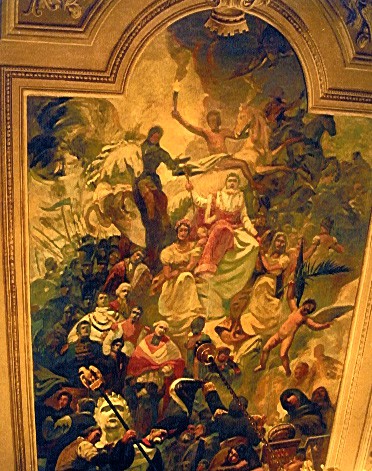
particular interest is the ceiling painted in allegorical homage to the
Emperor in 1940 by the Corsican painter Dominique Frassati. All the 'Egyptian' style furniture in the room belonged to the Cardinal.
The second room is more modest, displaying a large collection of coins
and medals. These came from the bequest by Prince Napoleon as well as
from gifts made in 1974 by the Danes Tave and Toge Vognsgaard.
The whole of Napoleonic history is present in these pieces minted in
commemoration of the important civil and military events of the
Consulate and the Empire.
Salon napoléonien, Hôtel de Ville – Ajaccio