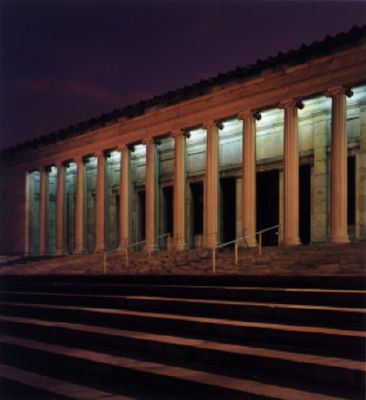
Edward Libbey, the Boston glass-maker, relocated his business to Toledo
because there was good sand available for making glass, cheap natural
gas, and the location strategic to railroad and shipping. Libbey and
his wife Florence Scott were the inspiration behind the birth of this
museum of art at the turn of the century. Their separate endowments
continue to represent an important source for museum operations and
acquisitions. George Stevens and Nina Spalding Stevens, two of
Toledo's favorite personalities, would direct the museum and
spend twenty-five years convincing Toledans, offering educational
and cultural programs for adults and children, that art was essential
to the community. Today, the museum houses, in addition to an
important and historical glass collection, an American wing, a
section on the art of the book, a selective collection of European
art, all set in spacious and welcoming setting. Baron Thyssen
“The Toledo Museum of Art is as wonderful for what it does not
have in its collection as for what it does.”
For Napoleonians, Antoine-Jean Gros' prize-winning Napoleon on
the Battlefield of Eylau, 1807 is not to be missed on your visit
to Toledo. Gros won the competition and the commission to
execute the painting now at the Musée du Louvre on the subject.
Napoleon and several of his generals, including Murat,
Berthier, Bessières, Caulaincourt, Soult, Davout and chief
surgeon Larrey figure in the painting. See also the casket
sculpted by Henry Auguste circa 1805.
The Second Empire has been wonderfully represented at the museum.
Albert Carrier-Belleuse's silvered bronze Hebe and the Eagle of
Jupiter signed and dated 1858, shown at the Paris Salon in 1859.
His bronze console table built for the famous courtesan the Marquise
de Païva should also form part of the visit. One of the crowning
pieces of their rich collection is an oversize cabinet, exemplary
of Second Empire style, decorated with the brilliant marquetry of
Joseph Cremer, shown at the London International Exhibition in
1862. A final piece to see is a Sevres footed bowl (1851-52) in
hard-paste porcelain decorated with enamel colors and gilding,
representative of the factory's new aesthetic concerns during
this period. The bowl was destined for the imperial residences.
Toledo Museum of Art