

Introduction
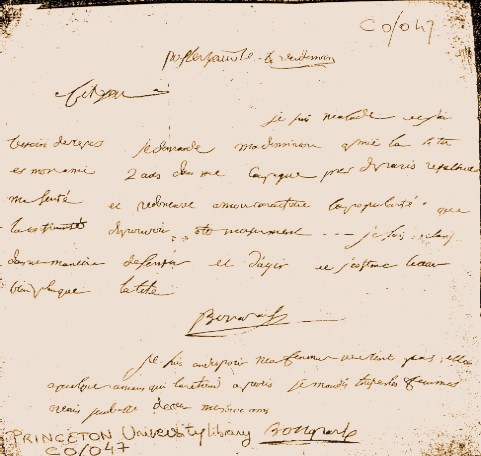
In the course of the project to publish the complete correspondence of Napoleon, I received from the University of Princeton (USA) a photocopy of a very interesting document. It was the body of a letter and a postscript, written by Napoleon Bonaparte to an anonymous citizen. In the body of the letter, the exhausted general-in-chief of the Army of Italy requests support for his request for leave from the army and asks for a place in France to be prepared for him where he could rest. In the postscript, he damns all women (particularly his own wife). The document seemed not to have been published before. I have called it (1). Shortly afterwards, I received from the University of Vilnius (Lithuania) a photocopy of document written by Bonaparte held at the library there. Strangely, this document was identical to that held at Princeton. I have called it (2). Since both (1) and (2) are in the hand of Napoleon, it is exceedingly unlikely that one is a copy of the other. Indeed, had they not both been period documents, you would have said they were photocopies. Subsequently, I discovered in the memoirs of the Count Horace de Viel-Castel a citation of another document (or possibly one of the two documents already mentioned) with the same contents as those held at Princeton and Vilnius. I have called it (3). After further research, other related documents began to appear, however, only containing parts of texts, in other words, either the body of the letter or the postscript, but not both. These are : a complete minute held at the S.[ervice] H.[istorique de l’]A.[rmée de] T.[erre], (France) (numbered 4), two texts published by Coston with facsimiles; numbered 5 and 6), a letter (previously part of the Brouwet collection; numbered 7), two texts published by Brotonne (numbered 8 and 9). I have called these the ‘partial documents’.
In this complicated situation, two questions are uppermost:
– are the Princeton/Vilnius documents composite facsimiles or originals?
– can the addressee, date and place of the letter and postscript be ascertained?
The first part of the discussion will concern the Princeton/Vilnius/Viel-Castel documents (1 to 3), the second section will deal with the ‘partial documents (4 to 9).
Description of the the Princeton/Vilnius/Viel-Castel documents
1: The Princeton document, comprising a letter and a postscript, both in the hand of Bonaparte
Shelfmark: Princeton University Library, General Mss [Misc.] C0047, Box NA, Subfolder 1, 1 letter [1796 ?]
Without addressee; place: Passeriano ; date : 4 Vendémiaire, 25 Septembre [1797], signed Bonaparte.
Despite the fact that the year is not recorded, the date 1797 is certain since we know that this was the only time Bonaparte was at Passeriano, in other words, September/October, 1797. The hand is that of Napoleon Bonaparte.
2: The Vilnius document, comprising a letter and a postscript, both in the hand of Bonaparte
Shelfmark: Vilnius University Library, VUBRS F48-300
Identical to the Princeton document.
3: Letter cited in the memoirs of the Count de Viel-Castel
Mémoires du comte Horace de Viel-Castel sur le règne de Napoléon III, 1851-1864, Paris: chez tous les libraires, 6 vol
Addressee: Barras; place: “Italy”; no date specified
«There is currently for sale at a dealer in armour, a curiosity enthusiast, residing on the Quai Conti, a letter of Bonaparte to Barras, dated Italy (sic). The future emperor complains about Josephine and her preference for staying in Paris with her lovers rather than to obey the call of duty and come to his side. The general complains greatly about women, says that he needs calm and rest, and desires to obtain leave for two years.», vol. 2, p. 100 (vendredi 19 novembre 1852)(Cited by Brotonne, Lettres inédites, Plon, 1898, note to letter No. 13 (see below, 8 and 9), although the page number is is incorrect – it should be 100 and not 121.)
This document would appear to be identical to the Princeton/Vilnius documents.
The text of the Princeton/Vilnius documents – a letter and a postscript
[Letter]
«Citoyen,
Je suis malade et j’ai besoin de repos, je demande ma démission, appuie-la si tu es mon ami. Deux ans dans une campagne près de Paris rétabliraient ma santé et redonneraient à mon caractère le popularité que la continuité du pouvoir ôte nécessairement… Je suis exclusif dans ma manière de sentir et d’agir et j’estime le coeur bien plus que la tête.
Bonaparte»
[Postscript]
«Je suis au désespoir ma femme ne vient pas, elle a quelque amant qui la retient à Paris, je maudis toutes les femmes mais embrasse de coeur mes bons amis.
Bonaparte »
(which translated reads: [Letter] “Citizen. I am sick and I need rest. I am requesting leave. Please, as you are my friend, support me in this. Two years on an estate near Paris would bring back my health and restore to my character the popularity which the continuity of power of necessity takes away… I am unique in my manner of feeling and acting, and I value the heart much more highly than the head. Bonaparte. [Postscript] I am in despair. My wife is not coming. She has a lover keeping her in Paris. Damn all women, but a kiss from heart to my true friends. Bonaparte”.)
Description of the ‘partial documents’
4: Document from the S.H.A.T., complete minute comprising the body of the letter on the Princeton/Vilnius documents
Shelfmark: S.H.A.T., C1712
Minute (copyist’s hand)
Addressee: Barras; place: Passeriano; date: 4 Vendémiaire, An IV (crossed out and corrected to An VI), 25 September, 1797.
The text here is that of the body of the letter of the Princeton/Vilnius documents, without the postscript.
5 and 6: The body of the letter and postscript of the Princeton/Vilnius documents published seperately with facsimiles by the Baron de Coston
Le baron de Coston, Biographie des premières années de Napoléon Bonaparte, c’est-à-dire depuis sa naissance jusqu’à l’époque de son commandement en chef de l’armée d’Italie ; avec un appendice renfermant des documents ou inédits ou peu connus, postérieurs à cette époque, Paris; Valence: Marc Aurel frères, 1840, 2 vols.
Coston published the body of the letter of the Princeton/Vilnius documents on page 484 of volume 1, with a facing facsimile, J – here marked 5
Without addressee but in Coston’s opinion it should be addressed to Barras (see Coston’s note below); place: Passeriano; date: 4 Vendémiaire (Coston dates the document to An VI, 1797)
Coston also published the postscript of the Princeton/Vilnius documents on page 466 of volume 1, with a facing facsimile, C – here marked 6
Without addressee but in Coston’s opinion it should be addressed to Barras; without place or date. In a footnote, Coston noted how the addressee could neither be Carnot nor Clarke. (Biographie, p. 484, note: “Since some people to whom I showed this letter thought that it could have been addressed to Carnot, or to General Clarke, I did some research which revealed to me that, 1° Carnot fell from power on 18 Fructidor, as Bonaparte already knew on the 26, as we can see from his letter to the Directoire, of that date; 2° though Clarke had been summoned from the Army of Italy in a bill passed by the Directoire exécutif on 18 Fructidor, An 5 (a bill which Général-en-chef Bonaparte affirmed that he had received on the 2nd complementary day of An 5, that is, 18 September, 1797), Clarke did not actually leave the army until 25 Brumaire, An 6.”)
7: Document once part of the Collection Emile Brouwet / Musée Napoléon in Digne-les-Bains (The Musée Napoléon in Digne-les-Bains was opened on 1 January, 1932, in a corridor in the Hôtel l’Hermitage (today a student hall of residence). The museum was dismantled in 1939. The major part of the Brouwet collection was sold at auction in 1934. The five volumes of the sale catalogue were entitled Napoléon et son temps: Catalogue de lettres autographes et documents historiques faisant partie de la Collection Emile Brouwet dont la Vente préparée par Jacques Arnna […] Hotel Drouot les 14 et 15 novembre 1934. A facsimile of this letter appears in the volume entitled Autographes, première partie, planche II, with the commentary on pages 2-3. A facsimile also appears in Jean Savant, Napoléon, Paris: Henri Veyrier, 1974, p. 56.) comprising a letter to Barras (text here below) and the postscript of the Princeton/Vilnius documents
Addressee: Barras; place: Milan; date: 23 Prairial, An IV (11 June, 1796)
A letter from Bonaparte to Barras (copyist’s hand) followed by the postscript (autograph, hand of Napoleon) of the Princeton/Vilnius document. According to the catalogue of the sale of the Brouwet collection, Bonaparte wrote the following address on the envelope in his own hand: “Au citoyen Barras, membre du Directoire, exécutif, Paris” (To Citizen Barras, member of the Executive Directory, Paris). (Text of the body of the letter to Barras: “Je te recommande, mon cher Barras, les Députés du Milanais, qui vont présenter leur hommage au Directoire, ce sont de bons patriotes qui voudraient établir la liberté dans Milan, avec d’autant plus de désintéressement qu’ils sont fort riches et jouissent d’une grande considération.” (“I recommend to you, my dear Barras, the deputies of the Milan region, who are coming to present their homage to the Directory. They are good patriots who wish to bring liberty to Milan, and they are all the more selfless in that they are exceedingly rich and highly respected.”))
8 and 9: The body of the letter and the postscript of the Princeton/Vilnius documents published separately by Léonce de Brotonne, Lettres inédites de Napoléon Ier, 1898, nos. 9 et 13
No. 13, body of the letter in the Princeton/Vilnius documents
Addressee: Barras; place: Passeriano; date: 4 Vendémiaire, An V[I] (25 September, 1797) (Brotonne gives “an V” but the 4 Vendémiaire, An V is the 25th September, 1796. Since we have the autograph for this document (i.e., the Princeton/Vilnius documents and the facsimile in Coston) in which the year is missing, we know that the year is a conjecture. Now, since Bonaparte was not in Passeriano in 1796, the correct date must be 1797, so the error in the dating in Brotonne is not for the Gregorian but rather the Republican calendar – “an V” should read “an VI”.) – here marked 8.
Brotonne published only part of the text (up to “santé”). It is possible that Brotonne took the addressee here, Barras, from Coston, whom he cites (No. 13, note 1).
No. 9, postscript of the Princeton/Vilnius documents
Addressee: Carnot; without place or date – here marked 9.
It is possible that Brotonne took the addressee here, Carnot, from Coston, whom he cites (No. 13, note 1). In a note to No. 9, Brotonne dated this postscript to the “derniers jours de prairial an IV (mai 1796)” (the last days of Prairial, An IV (May 1796)).
Discussion and conclusion
Coston (1840) and Brotonne (1898) (Brotonne (1898) is not to be excluded from the discussion as being derived from Coston. Firstly Brotonne described these writings as previously unpublished (inédits) – although he did notice (later, I would argue, during the publishing process) that the postscript had indeed been published (No. 13, note 1 “the note 9 on page 6” [i.e., the postscript] “is not previously unpublished but was reproduced by Coston: Biographie, etc., II, 466”). Furthermore, that Brotonne only published a part the body of the letter of the Princeton/Vilnius document, when it was published complete in Coston, would lead us to believe that his source was something other than Coston.) published the body of the letter and postscript of the Princeton/Vilnius document separately (with facsimiles in Coston). The minute from the S.H.A.T. also shows us the body of the letter of the Princeton/Vilnius document on its own (without postscript). As for the addressee, despite the fact that the autograph (Princeton/Vilnius and the facsimile in Coston) does not have one, the minute from the S.H.A.T., Coston, and Brotonne are unanimous in their addressing of the body of the letter of the Princeton/Vilnius document to Barras and that the letter was dated 25 September, 1797. On the other hand, the other letter addressed to Barras (previously the Brouwet collection), shows us the Princeton/Vilnius postscript attached to a different letter body dated a year earlier. Is it possible that the Princeton and Vilnius documents (and that mentioned in the Memoirs of Viel-Castel) are compilations of documents of different dates, even though they are apparently originals and in the hand of Napoleon?
On taking a closer look at the chronology here and the history of the intertwining relations of Bonaparte, Barras and Josephine, however, clues appear.
To take the postscript first. The letter to Barras (previously Brouwet collection) sets the postscript in June 1796. This date is perfectly suitable. Bonaparte married Josephine in March 1796, but left almost immediately for Italy. In June, he was impatiently expecting her arrival. But she was dragging her heels in Paris. The postscript reveals to us an anxious husband residing in Milan, slipping a note to a close friend of his and his wife’s, Barras (Carnot was never so close to Bonaparte), at the end of an official letter (but which Bonaparte clearly sent personally, as he wrote the address himself – see above note). The postscript could easily be dated 11 June, 1796 (Brotonne too proposed May/June 1796 for the postscript on its own). Josephine arrived in Milan on 10 July 1796. (It is true that the letter to Barras (previously Brouwet collection) could also be a compilation – indeed the postscript appears to exist on its own. But since there is really no doubt as to that letter’s authenticity, there is no reason to look further.)
In this light, the postscript does not appear to belong to a letter from Passeriano dated 1797. But there is further, more powerful evidence that the postscript does not belong with the Passeriano letter of 1797 and that the Princeton/Vilnius documents are compilations.
We know that for the body of the letter of the Princeton/Vilnius documents, the date is September 1797. (Bonaparte was not in Passeriano in 1796.) In addition to the fact that the Bonaparte was in fact in Passeriano in September/October 1797, the First Italian Campaign was finishing and Bonaparte, tired, needed a rest, as the letter expresses. Naturally, he asked support for his request for leave. Chronology and content fit perfectly. As noted above, all sources (except the Princeton/Vilnius documents) give Barras as the addressee – who better could have supported his request? But what of the postscript (“I am in despair. My wife is not coming. She has a lover keeping her in Paris. Damn all women…”)? In addition to the circumstantial evidence that it was written in Milan, we can also state categorically that it could not have been written as a postscript to the Passeriano letter of 1797, for the simple reason that at that time Josephine was at Bonaparte’s side in the Villa Manin, Passeriano. Furthermore, Josephine wrote to Barras at the end of September 1797 telling him that Bonaparte loved her more than ever!
To recapitulate: the minute of the S.H.A.T., Coston, (and Brotonne partially) show a letter from Bonaparte, without postscript, to Barras, asking for support for his request for leave, 25 September, 1797. The letter (previously Brouwet collection) shows us a postscript by Bonaparte (again written to Barras) furious with women in general and Josephine in particular, 11 June, 1796. This postscript could not have been written in Passeriano in September 1797. As a result, the documents from Princeton and Vilnius (since they are autographs) are compilations, made before 1852 (the date of the memoirs of the Baron de Viel-Castel), but since they are facsimiles they are also useful for the reconstitution of the text of these two communications (being in the hand of Napoleon). There is however no doubt that they are forgeries. (Other examples of facsimiles made before the invention of photography can be seen in Copies of original letters from the Army of General Bonaparte in Egypt, London: Wright, 1799 and also in Coston’s Biographie (1840).)
Postscript
Subsequent to writing this article, yet another example of the body of the letter of the Princeton/Vilnius type surfaced. Whilst its existence does not change any of the conclusions above here, it does however alter the final description of the body of the letter in the Princeton and Vilnius documents. A facsimile of this text was published by Jacques Arnna in Pages de l’épopée imperiale impériale, Tours, 1952, pp. 86-88. The date (4 Vendémiaire [1797]), place (Passeriano) and writing (Bonaparte’s) are identical (of course, since Princeton and Vilnius are as we know facsimiles). But there are two important differences. The Arnna letter is explicitly addressed to Barras (as opposed to an anonymous ‘Citoyen’), and secondly the body of the letter of the Princeton/Vilnius documents appears within the body of another, much longer letter. (“Barras, J’ai été aussi surpris que tout homme l’aurait été à ma place de la conduite que l’on a tenue à mon égard. L’on me traite comme si mes sentiments étaient suspects. Augereau, par une indigestion de pouvoir bête, écrit des lettres qui le rendent la fable et le ridicule de l’armée, en même temps qu’elles font penser bien des choses qui, peut-être, ne sont pas. Un nuée (de pleutres niais?) vont prétendre tout blamer comme tout juger. Je suis malade… et j’estime le coeur bien plus que la tête des hommes qui vont dominer les conseils et l’opinion. Je te prie surtout d’avoir soin que l’on accuse de rien le jeune aide de camp d’Augereau. C’est un de mes meilleurs soldats, brave et bon. Je l’ai vu avec plaisir et je l’aime. Je t’embrasse; au revoir, à bientôt, j’espère, Bonaparte”. Translation: “Barras, I am as surprised as any man would be in my place concerning the conduct held towards me. I am treated as if my feelings were suspect. Augereau, in an indigestion of senseless power, has written letters which render him the talk and ridicule of the army. And at the same time they make people think things that are perhaps not true. A crowd (of useless idiots?) will try to criticise everything as well as judge everything. I am ill… I value the heart much more highly than the head of the men who are going to dominate the councils and public opinion. Please take care above all that no-one accuses Augereau’s young ADC of anything. He is one of my best soldiers, brave and good. I have happily watched him and delight in him. I kiss you. Goodbye and see you soon, I hope.”) This new document would appear to be the original from which the body of the letter in the Princeton and Vilnius documents was snatched. Interestingly (and more logically, from what we know of Bonaparte) the Arnna letter sets Bonaparte’s demand for support for his discharge within the context of his rivalry with Augereau, and it finishes the (we now see) incomplete last sentence in the Princeton/Vilnius documents. The Princeton/Vilnius/Viel-Castel documents are not only compilations of three facsimiles (the word ‘Citoyen’ is taken from a third source), they are also incomplete.
Given that we now know that body of the letter of the Princeton/Vilnius documents is an excerpt, it is possible to approach the question why this compilation was made. It would not appear to be a facsimile cut from a book – if it were, what sense would there be in removing the addressee and replacing it with the banal ‘citoyen’. The effort made to find the word ‘citoyen’ in Napoleon’s hand and then to paste it here seems particularly suspicious. I would venture that it is the work of a forger trying to make his forgery harder to track down. Furthermore, now that we know the real context for the body of the letter, there would appear to be an agenda leading the forger to extract text from the Arnna letter and set it alongside the Milan postscript. by this outrageous unhistorical juxtaposition Napoleon is made to appear ‘tired and emotional’, worn out by campaigns, and worn down by his ‘amours’. Clearly such a ‘desperate’ and personal letter is closer in style to Napoleon’s love letters to Josephine and as a result could be thought to command a much higher price in a sale.