

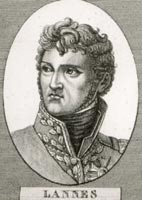
Fact file
Born Lectoure (Gers), 10 April, 1769, died Eberdorff (Austria), 31 May 1809.
Volunteer in 2e bataillon de Gers, 1792
Armée des Pyrénées-Orientales, 1793-95
Wounded in the arm, Banyuls
Commanded the avant-garde of the Brigade Laterrade at the taking of the camp at Villalonga, 19 December, 1793
Chef de brigade de grenadiers in the same battalion, 25 December, 1793
Passed over to the Armée d’Italie, fighting at Loano (24 November, 1795), Voltri (9 April), Millesimo (14 April), Dego (15 April), Fombio (8 May), Lodi (10 May), Pavia and Binasco (where he set fire to the village, 26 May), Saint-Georges (4 June), Arquata and Livorno (20 June), Bassano (8 September), Due Castelli (14 September), Governolo (15 September), Arcole (15 November), Lodi (13 December), Senio (3 February), Ancona (9 February)
Attached to the Armée d’Angleterre, 12 January, 1798, fighting at Malta (10 June), the taking of Alexandria and Rosetta (26 July), put down the Cairo revolt (21 October)
Commanded a division in the Armée de Syrie, fighting at El-Arysch (20 February), Jaffa (7 March), wounded in the head in the attack on St Jean d’Acre (8 May), Aboukir (wounded in the leg at the siege of the fort, 27 July)
Left for France with Bonaparte, 22 August, 1799
Disembarked with him at Saint-Raphaël, 9 October
Took part in the coup d’Etat of 18 Brumaire by commanding headquarters at the Tuileries, 9 November
Commandant extraordinaire of the 9e and 10e divisions militaries, 12 November to 27 December
Commandant and Inspecteur général of the Garde Consulaire, 16 April, 1800
Commandant of the Avant-Garde of the Armée de Réserve, 10 May, 1800
Crossed the Great St Bernard Pass and took Aosta, 16 May
Fought at Châtillon (18 May), Chiusella (26 May), Pavia (2 June), Montebello (9 June), Marengo (he withstood the Austrian attack for 7 hours, for which he received from Bonaparte a ‘sabre d’honneur’, 14 June)
Plenipotentiary minister and sent to Portugal, 14 November, 1802
Returned to France after trade difficulties to become Commandant of the Camp d’Ambleteuse, 4 July, 1803
Maréchal d’Empire, 19 May, 1804
Chef of the 9e cohort of the Légion d’Honneur
Grand croix du Christ de Portugal, 1805
Grand Aigle of the Légion d’Honneur, 2 February, 1805
Commandant of the Avant-garde of the 5e corps of the Grande Armée, 23 August, 1805
Fought at Weringen (8 October), Ulm, Braunau (30 October), Hollabrunn (16 November)
Commanded the left wing at Austerlitz, 2 December, 1805
Commandeur of the Couronne de Fer, 25 February, 1806
Commandant of the 5e corps of the Grande Armée
Fought at Saalfeld (10 October), commanded the centre at Iéna (14 October), victor at Pultusk (26 December 1806, slightly wounded)
Left his command on health grounds, January 1807
Grand croix of the order of Saint-Henri de Saxe
Commandant of the Corps de Réserve of the Grande Armée, 5 May to 12 July, 1807
Fought at Danzig (20 May), Heilsberg (10 June), commanded the centre at Friedland, 14 June, 1807
Colonel general of the Suisses, 13 September, 1807
Chevalier of the order of Saint-André de Russie, 1808
Duc de Montebello, 15 June 1808
At headquarters in the Armée de l’Espagne, October 1808
Led the 3e corps to victory over Castanos at Tudela, 23 November, 1808
Following a fall from his horse, he stood down as commander and returned to headquarters, 2 December, 1808
Commanded the siege of Saragossa, which capitulated 21 February, 1809
Called to serve in the Armée d’Allemagne, reaching headquarters on 19 April, 1809
Fought at Landshut (21 April), Eckmühl (22 April), Ratisbon (23 April)
Took command of the 2e corps of the Armée d’Allemagne, 24 April, 1809
Fought at the siege of Vienna (11 May) and Essling (21 May) where he died from his wounds and the ensuing amputation
Buried in the Pantheon
A mere volunteer who became a soldier of extraordinary bravery and sang-froid, literally covered in scars, Lannes was a key figure in Napoleon’s military success. Very much down-to-earth (in Italy when offered the Pope’s hand to kiss, he firmly shook it). Lannes was reached his zenith of popularity (particularly amongst his men) in April 1800 was he was appointed Inspecteur general of the Garde Consulaire. But his friendship with Bonaparte was not however without its ups and downs – his popularity was seen by Bonaparte as a challenge and his obstinate use of ‘tu’ to the Premier Consul at a time when Napoleon wished to distance himself led to his exile by promotion to the post of Plenipotentiary in Portugal. He was very successful as a commandant in the Grande Armée and his death at Essling was deeply felt by Napoleon and the Grande Armée.
Further reading
Thoumas, Le Maréchal Lannes, Paris: Calmann Lévy, 1891
Zins, R., Le Marechal Lannes: favori de Napoléon, Entremont le Vieux: Le Temps Traversé: Editions Curandera, 1994