

Fact file
Born La Bastide-Fortunière, 25 March, 1767, executed Pizzo (Calabria) 13 October, 1815.
Married Marie Annunziata, ‘Caroline’ Bonaparte 20 February 1800
Maréchal-de-Logis of 12th regiment of chasseurs, 15 March 1792
Sous-lieutenant of the escadron franc, Arras, 15 October 1792
Capitaine-aide du camp to General d’Urre, 14, April 1793
Chef d’escadron, 1 May 1793
Participated with Bonaparte in the crushing of the Royalist insurrection led by Danican, 5 October, 1795
Chef de brigade 2 February, 1796
Premier aide du camp to Bonaparte for the First Italian Campaign
Brigadier general, 10 May 1796
Commander of the province of Kelioub during Egyptian campaign
Division General, 25 July, 1799 on the battlefield at the Battle of Abukir (land)
Lieutenant general in chief of the Armée de reserve and commander of the cavalry, 20 April, 1800
Took Vercelli (27 March), Piacenza (4 June), and received a sabre d’honneur for his part in the Battle of Marengo (14 June)
Commander of the Armée de Réserve near Dijon 20 November 1800
Drove the Neapolitan army from the Papal States, 6 February 1801, imposing the Peace of Foligno on the King of Naples
Commander of the Armée d’observation du Midi in the kingdom of Naples and seized the island of Elba
President of the collège electoral of the Lot
Député at the Corps législatif in 1804
Governor of Paris, 15 January, 1804 (during the Duc d’Enghien affair)
Maréchal de l’Empire, 1804
Grand amiral, prince and grand aigle of the Légion d’Honneur, and Chef of the 12th cohort of the Légion d’Honneur
Grand Duke of Berg and Cleves, 30 March 1806
Commandant général of the cavalry – pinned down the Austrian army at Ulm leading to their surrender, defeated the Austrian and Russian cavalry at the Battle of Austerlitz
Complete destruction of the Prussian army at Iena, 1806
Desperate successful charge at Eylau, 1807
Emperor’s lieutenant in Spain, 1808, quashing of the ‘Dos de Mayo’ uprising
Decreed Joachim-Napoleon (Gioacchino-Napoleone) I, king of Naples, 15 July 1808
Distinguished action at the Battle of Borodino, 7 September, 1812
Negotiations with Austria and England, 1813
Signed treaty with Austria, detaching Naples from the Empire, 11 January, 1814
Attempt at unifying Italy, Neapolitan troops drive the Austrians as far as the Po and Ferrara but driven back and defeated at the Battle of Tolentino, 2-4 May, 1815
Absent from Waterloo, Murat fled to Corsica after Tolentino
Returned to Naples with six ships and a handful of men.
Captured at Pizzo and executed there 13 October, 1815
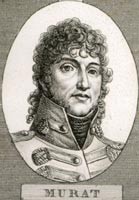
From modest beginnings (he was the son of an innkeeper) Murat saw probably the most stratospheric rise of all Napoleon’s entourage. His ability initially as a simple cavalryman and later as a cavalry commander was prodigious. It was his provision of 40 cannons to fight the Royalist uprising of 13 Vendémiaire which first brought him into contact with Bonaparte, and he after distinguished himself not only in the First Italian Campaign at Dego and Mondovi but also in the Second, notably at Marengo, becoming one of Napoleon’s closest associates, fighting with the cavalry throughout the whole of the Consulate and the Empire. His most glorious action was probably at Iena where he completely destroyed the Prussian army and caused Blücher to capitulate. As Murat remarked ironically in a letter to Napoleon, ‘Sire, the battle is over because there is no one left to fight’. The only major battle he missed (perhaps significantly, along with Berthier) was Waterloo. Although Governor of Paris, he nevertheless took a back seat in the Duc d’Enghien affair and did not stand in Napoleon’s way. He was in the end rewarded with the kingdom he so much sought after, namely that of the Two Sicilies, but not without strings attached. The title King Joachim-Napoleon was imposed, as was the clause that on his death Caroline his wife would become sole ruler. Berthier reminded Murat that ‘for your subjects you must be the king: but for the Emperor you must be viceroy’. Nevertheless, Murat threw himself heartily into the job of ruling Naples, modernising his kingdom with the bringing of the Code civil, the breaking up of the vast landed estates, with his foundation of a university and a naval academy, his encouragement of the cotton industry, and his effective solution to the problem of Brigands. Disagreements with Napoleon and Caroline his wife however led to tension in the kingdom, and he abandoned command of the shattered Grande Armée on the retreat from Russia in 1812 (handing it to Eugène de Beauharnais) to return to stabilise his kingdom in Italy. An unsuccessful treaty with Austria and the fact that he was not recognised as lawful ruler by the allies during the First Restoration led to his (in the end fruitless) attempts to rejoin Napoleon for the Hundred Days. He tried to play the card of Italian unification in order to provide himself with a role and defence from Austria, but the defeat at Tolentino put an end to his hopes. Given the context, his landing at Pizzo almost seems like an attempt at suicide.
Further reading
Lacour-Gayet, M., Joachim et Caroline Murat (preface by Jean Tulard), Paris: Perrin, 1996
Tulard, J., Murat ou l’Eveil des Nations, Paris: Hachette, 1983
Hulot, F., Murat: la chevauchée fantastique, Paris: Pygmalion-Gérard Watelet, 1998
Tulard, J., Murat, Paris: Fayard, 1999