![]() |
|
|
|
|
|
Home > Essential Napoleon > FAQ |
|
|
Answers to some of your most frequently asked questions, whether on the history of the First and Second Empires or simply about the Fondation Napoléon.
For further information on this section, please contact Peter at hicks(at)napoleon(dot)org.
On 15 May, 1768, France and Genoa signed a treaty, on the terms of which France was to take possession of Corsica and keep it until Genoa could pay back what it owed to France. In reality, France bought Corsica, spending 40 million livres. Then on 15 August of the same year an edict was passed linking Corsica to France. Certain of Napoleon Bonaparte's detractors declared that he was not French because he was born in 1768 and not 1769, and that his date of birth had been falsified, it being unthinkable that the emperor of the French not be French himself. However, no serious proof has ever been produced to challenge the accepted date of 1769.
Before beginning his autopsy on the body of Napoleon, Antommarchi measured it. It came to 1.686 metres (see the Memoirs of Marchand).
Antommarchi's autopsy report is very complete and shows Napoleon's general state of health at his death, notably a chronic stomach ulcer and pulmonary lesions linked to tuberculosis. Cancer cannot be diagnosed because of a lack of histological evidence from the stomach lining. At any rate, one does not die 'of cancer', one dies of the effects of the cancer on the organism.
Analysis of the emperor's hair and the discovery of high level of arsenic therein poses several questions. But it is intellectually impossible to accept the theory of death by arsenic poisoning. First of all, we can never be 100% certain that the hairs analysed come from Napoleon. Furthermore, the level of arsenic could be interpreted in different ways, notably the methods of analysis and the ways of calculating the levels used by the toxicologists (numbers obtained weighed against the number of hairs analysed: in fact, very few hairs have been analysed. Whilst presence of arsenic cannot be explained arguing from its external use (in cosmetics, for example), we still do not know where the arsenic came from, and it could have come from many sources. The hairs on the head of the people in Napoleon's entourage could also have a high arsenic content. Finally, to pass from toxicological results to a poisoning theory, then to a voluntary criminal act is very difficult. Indeed, one cannot establish a theory, accepting certain elements of the correspondence of one of the protagonists whilst eliminating other elements two paragraphs further on which contradict this position. The only certainties thus are, Napoleon's general state of health was very poor and no direct cause of death can be determined accurately. This is the only satisfactory conclusion from an ontological point of view, both for the scientist and for the historian. A deeply held conviction may be the starting point of an investigation but certainly not its conclusion. According to Thibaudeau, Napoleon used this term (in the same speech containing the famous remark that men could be led 'by baubles') in the debate in the Conseil d'Etat on the creation of the Légion d'Honneur. The term referred to the 'notables' (the granite foundations of the house) upon whom Napoleon wished to found French society.
The nobility of the First Empire was a key element in Napoleon's reconstruction of France, and the emperor saw them as a means of uniting the country and building the nation. It is hard to say with any accuracy because there are no accurate lists of those wounded or killed. The lists made subsequently are based on the analysis of disparate and incomplete archives. That being said, a very broad estimate of the number of those wounded and killed (or died as a result of their wounds) during the wars of the Consulate and the Empire would be between 500,000 and 700,000.
The first two coalitions were against Revolutionary France.
In 1793-1795, the members were England, the United Provinces, Prussia, Austria, Spain, Portugal, Piedmont-Sardinia, the Papal States,and the Kingdom of the Two Sicilies In 1798-1799, the members were England, Austria, Russia, the Kingdom of the Two Sicilies and the Ottoman Empire The third coalition in 1805 comprised Britain, Austria, Russia and Naples The 'fourth coalition' in 1806 was made up of Britain, Russia and Prussia The fifth coalition (from 1808 to 1809) linked Britain with Austria and Spain The sixth from 1813 to 1814 comprised Britain, Austria, Sweden, Russia and Prussia. The only means at present is by boat (althought there are plans to build an airstrip). The voyage goes from Cardiff (Wales) or Falmouth (England) to Tenerife, Ascension and then Saint Helena and takes 15 days - those in a hurry can fly to Cape Town and take the boat from there (only 6 days).
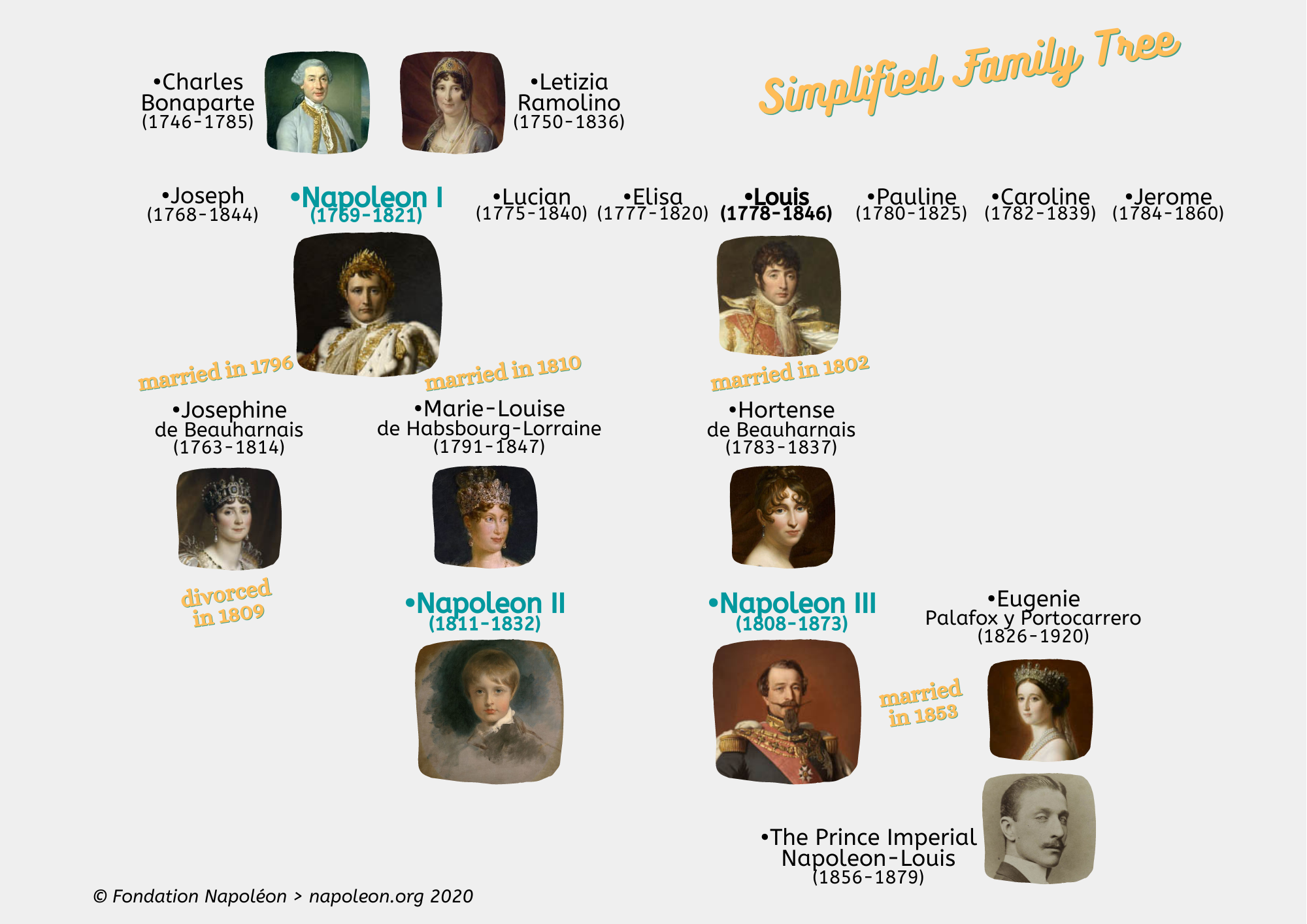
For more information, visit the following sites: Tourist Office: http://www.sthelenatourism.com/ Saint Helena information site: http://www.sthelena.se/index.htm Cruises: http://www.rms-st-helena.com/Default.htm Napoleon III was the third son of Louis Bonaparte (1778-1846), who himself was the third brother of Napoleon I.
Hortense de Beauharnais (1783-1837), daughter (by her first marriage) of Josephine, was the mother of Napoleon III. When the Second Empire was proclaimed on 2 December 1852, president Bonaparte took the name Napoléon III, considering that the Aiglon (Napoleon I's son by Marie-Louise), proclaimed emperor by the 'chambres' in 1815, had in fact reigned.
At the Service Historique de l'Armée de Terre, (SHAT), Pavillon des armes, Château de Vincennes, BP 107, 00481 Armées. Tel.: 01 41 93 34 80 or 01 41 93 34 44.
In the following volumes (still on sale): - Georges Six: Dictionnaire biographique des généraux et amiraux français de la Révolution et de l'Empire (1792-1814), Paris: Librairie G. Saffroy, 1934, 2 vols. Republished in 1976. - B. Quintin: Dictionnaire des colonels de Napoléon, Paris: Editions SPM (34 rue Jacques Louvel-Tessier, 75010), 1996, 985 p. - A. Chappet, R. Martin, A. Pigeard, A. Robe: Répertoire mondial des Souvenirs napoléoniens, Paris: Editions SPM, 1993, 862 p. |
| Site map | Contact us | Add to your favourites | Crédits | Fondation Napoléon |
| © Copyright 2006 - Fondation Napoléon |