

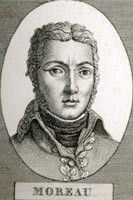
Fact file
Born Morlaix (Brittany), 14 February, 1763, died Lahn, (Bohemia) 2 September, 1813.
Married Mlle Hulot, 9 November, 1800
Son of a Breton lawyer, Moreau himself also studied law (at Rennes).
Formed a company of Cannoniers de la garde nationale in Rennes and became captain in it, 1789
Lieutenant-Colonel of the 1st Battalion of volontaires d'Ille-et-Vilaine, 11 September, 1791
With Champmorin in Belgium he took the fort of Stephenswerth, 9 February, 1793, and distinguished himself at Neerwinden, 18 March.
Provisionally nominated Brigadier General, 20 December, 1793
Joined Pichegru, commander of the Armée du Nord, as was made Général de division in command of the 2nd division of the Armée du Nord at Cassel, 14 April, 1794
Replaced Pichegru as head of the Armée du Nord, 3 March 1795
Left the Armée du Nord to replace Pichegru as head of the Armée du Rhin-et-Moselle, 14 March, 1796
Campaign against the Archduke Charles
Victories at Kehl, Rastadt, Ettlingen, Neresheim, reaching and occupying Munich,
August, 1796
Measured retreat following Jourdan's defeat, 11 September, 1796
At the beginning of the Peace of Leoben, captured Klinglin's carriage and with it letters to the Austrians from Pichegru, 24 April, 1797
Sent these letters to the Directory, 5 September, 1797.
Recalled to Paris, 2 September, arriving on 14 September
'Mis en reforme' 23 September
Commandant of 3 divisions of the Armée d'Italie under Schérer at Pastrengo (26 March 1799), Magnano (5 April)
Took over from Schérer as commander of the Armée d'Italie, 21 April
Beaten at Cassano d'Adda, victor at San Giuliano
Took command of the Armée d'Italie on Joubert's death at the Battle of Novi, 15 August, 1797
Stepped down from command of the Italian force on 21 September and returned to Paris 9 October where he met Bonaparte (22 October)
Played a small role in the Brumaire coup d'Etat, keeping the Directors Gohier and Moulin under house arrest at the Palais de Luxembourg
Bonaparte then made him Commander in chief of the joint Armées du Rhin et d'Helvétie, 23 November, 1799
Victories over Kray at Engen, Messkirch, Biberach, and Höchstädt (May and June 1800)
Victory at Hohenlinden over the Archduke Charles, 3 December, 1800.
Pursued the Austrians as far as Steyer (170 km from Vienna) where an armistice was signed, 25 December, 1800
Member of the Légion d'Honneur, 10 December 1803
Opposed Bonaparte, entered into relations with Pichegru who was plotting to overthrow the First Consul. After meeting in Paris, Moreau accepted the idea of overthrowing Bonaparte but not to serve the Bourbons.
Arrested 15 February, 1804, with Cadoudal and Pichegru, and imprisoned in the Temple
Received a sentence of 2 years in prison, 10 June.
Requested and obtained permission to exile himself to the United States
Settled in Morrisville, Pennsylvania, on the Delaware river
Called back to Europe by the Tsar, he disembarked at Gothenburg (Sweden) 26 July, 1813
Arrived in Prague, 17 August, 1813, met with allies and joined their attack on Dresden.
A cannon ball removed lower part of right leg at the Battle Dresden, 27 August, 1813
Taken to Lahn where he died from his wounds – he was buried in a Catholic church in St Petersburg.
Moreau clashed with Napoleon many times and to begin with Napoleon's policy was to attempt to draw him into his sphere of influence as he had done with his other Generals. But Moreau was more of a threat in that his military action at Hohenlinden, in terms of numbers captured and the effectiveness of the strategy, was a much greater success than Marengo. But perhaps it was prudence (and finally lack of overpowering ambition) which led him to miss his chance when he could have invaded and was encouraged to take Vienna in 1800. His involvement with Pichegru and Cadoudal would appear to be more linked to a great dislike of Bonaparte (indeed in the years before the lack of entente cordiale was open, Moreau openly ridiculed the Concordat, the 'Légion d'Honneur', the Consulate, and refused to marry Hortense de Beauharnais, Bonaparte's step-daughter, marrying mademoiselle Hulot whose Creole family detested Josephine's) rather than to any desires for a return of the Bourbons. But unlike the Duc d'Enghien, Napoleon was unable to get rid of Moreau. During the Cadoudal/Pichegru/Moreau trial, Napoleon could not achieve the result he wanted largely apparently owing to the lack of solid proof but also as a result of Moreau's enormous popularity. Indeed, the story goes that General Lecourbe took Moreau's son to the trial and in the middle of the sitting stood up saying ‘Soldiers, here is the son of your general', at which all the military in the room presented arms. At the first attempt at judgement, Moreau was acquitted by a vote of seven judges against five. Thuriot, the judge and 'instructeur', demanded the death penalty, declaring that since the affair was a political one, and in order to avoid a coup d'Etat, desperate remedies were required. At the second vote, a compromise of two years imprisonment was agreed upon with a majority of 8 votes. Bonaparte was reportedly furious and called for Moreau's exile. After apparent retirement (“J'y mène une vie très monotone, mais très tranquille” wrote the General concerning his US stay to his brother Joseph Moreau, 17 November, 1806, Philadelphia) in Pennsylvania, Moreau was called back to fight in the Old World by the Tsar. However injured at the Battle of Dresden, he later died of his wounds.
Further reading
Garçot, M., Le Duel Moreau-Napoléon, Paris, Nouvelles Éditions latines [1951]
Savinel, P., Moreau, rival républicain de Bonaparte, Rennes: Ouest France, 1986