

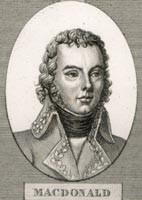
Fact file
Born Sedan (Ardennes), 17/ November, 1765, died in the Château de Courcelles-le-Roi (Beaulieu dur Loire, Loiret), 25 September, 1840.
Son of a Scottish Jacobite
Served in the Légion Irlandaise, 1784
Lieutenant in the Régiment de Maillebois (served Holland), 1 April, 1785
Volunteer in the Régiment de Dillon (became the 87e Infanterie, 1791), 12 July, 1786
Lieutenant, 10 October, 1791
Beurnonville's aide-de-camp, 17 June, 1792
Capitaine, 19 August, 1792
Dumouriez's aide-de-camp, 29 August, 1792
Served at Jemappes, 6 November, 1792
Lieutenant-colonel in the 94e d'infanterie, 12 November, 1792
Chef de brigade of the 2e d'infanterie, 8 March, 1793
Took Blaton, 18 August, 1793
Général de brigade in the Armée du Nord, 26 August, 1793
Served in the Combat de Tourcoing (27 August) and at the taking of Werwicq and Menin (13 September)
Joined the Division Souham, 11 October, 1793
Victor Werwicq, 23 November, 1793
Served at Courtrai (11 May, 1794), the Battle of Tourcoing (18 May), and Hooglède (13 June)
Covered the siege of Bois-le-Duc, 23 September, to 9 October, 1794
Replaced Souham as Commandant of the 1er Division, 15 November, 1794
Général de Division in the Armée du Nord, 28 November, 1794
Took the Fort of Knotzemburg, 11 January, 1795
Appointed Commandant of the 2e Division of the Armée du Nord (in place of Compère), 21 May, 1795
As a result of complaints from the government of Holland, appointed Commandant in Sélande of the 3e Division of the Armée du Nord, 2 August, 1795
In charge of three divisions (Macdonald, Daendels and Dumanceau) ordered to cover the left wing of the Armée de Sambre-et-Meuse, 10 July, 1796
Commandant of the left wing of the Armée de Sambre-et-Meuse, 24 September, 1796
Commandant of the 1ere Division of the Armée du Nord, February, 1797
Joined the Armée d'Italie, 24 April, 1798
Commandant of the French stationed in the Roman Republic (in place of Gouvion-Saint-Cyr) 11 July, 1798
Commandant of the 1ere Division of the Armée de Rome and Governor of Rome, 19 November, 1798
Victor at Faventino but nevertheless evacuated Rome and then fought at Cività Castellana, 5 December
Victor at Otricoli, served at the taking of Calvi, successfully attacked Capua (-3 January, 1799)
Resigned after disagreement with Championnet, 11 January, 1799
Took Championnnet's place as commandant en chef of the Armée de Naples, 27 February, 1799
Victor (but wounded) at Modena, 12 June, 1799, after the evacuation of Naples
Beaten at Trebbia, 17-19 June, 1799
Joined the Armée d'Italie, 3 July, 1799
On leave, 15 July, and left active service, 3 August, 1799
Commandant at Versailles during 18 Brumaire, 9 November, 1799
Sent to the Armée du Rhin as lieutenant to the Général en chef, Moreau, 7 December
Lieutenant to the Général en chef of the Armée de Réserve, 7 December April, 1800
Commandant en chef of the 2e Armée de Réserve, 24 August, 1800
Commandant en chef of the Armée des Grisons, 5 October, 1800
Crossed the Splügen (4 December, 1800) and took Trento (6 January, 1801)
Left the Armée des Grisons to become Ministre Plénipotentiare in Denmark, 1 April, 1801
Returned to France at the end of January, 1802
Disgraced for having defended Moreau in 1804
Authorised to serve in Naples, 28 February, 1807
Employed in the Armée d'Italie, 28 March, 1809
Commandant of a corps under Prince Eugène, 20 April, 1809
Commanded the right wing of the Prince Eugène's army, 28 April, 1809
Wounded at the battle of Piave, 8 May, 1809
Took Laiboch (22 May, 1809) and Graz (30 May, 1809)
Broke the enemy centre at Wagram thus deciding the victory, 6 July, 1809
Maréchal d'Empire, 12 July, 1809
Grand Aigle of the Légion d'Honneur, 14 August, 1809
Received an annual rent of 60,000 francs from Naples
Duc de Tarente, 9 December, 1809
Recalled to Paris, 9 January, 1810
Commandant en chef of the Armée de Catalogne (in place of Augereau), 24 April, 1810
Victor at Cevera (5 September, 1810), took Manresa, but was held back at Bisbal and Valls (15 January, 1811)
Returned to France after 20 September, 1811
Commandant of the 10e corps of the Grande Armée in Russia, 3 June, 1812
Unsuccessful siege of Riga August to December, 1812
Ceded command of the 10e corps to Rapp, 13 January, 1813, and was placed in the Etat-major general
Commandant of the 11e corps of the Grande Armée in Sachse, 10 April, 1813
Victor at Merseburg, 29 April, 1813
Commandant of the right of the army at Lützen, 2 May, 1813
Victor at Bischofwerda, 12 May, 1813
Commander of the right at Bautzen, 20-21 May, 1813
Beaten at Katzbach, 26 August, 1813
Fought at Wachau, 16 October, 1813 the 'Battle of the Nations'
Fought at Leipzig, 18 October, the 'Battle of the Nations'
Escaped by swimming the Elster, 19 October, 1813
Fought at Hanau, 30 October, 1813
In charge of the defence of the Lower Rhine border near Cologne, 1 November, 1813
Retreated to Châlons-sur-Marne, January, 1814
Retreated to Meaux, 4 February, 1814
Fought in retreat at Mormant, (17 February), La Ferté-sur-Aube (28 February), Troyes (4 March), Nogent-sur-Seine and Provins (17 March), and Saint Dizier (29 March)
Chosen by Napoleon, along with Ney and Caulaincourt, to negotiate with the allied sovereigns, 4 April, 1814
Member of the Conseil de Guerre, 6 May, 1814
Pair de France, 4 June, 1814
Governor of the 21e division militaire in Bourges, 21 June, 1814
Commandant of the Armée du Gard, under the Duc d'Angoulême, 6 March, 1815
Accompanied the Comte d'Artois to Lyons, 8 March, 1815
Commandant en chef of the combined army for the defence of Paris, under the orders of the Duc de Berry, 17 March, 1815
Followed Louis XVIII to the border and then returned to Paris where he served as a Grenadier in the Garde nationale
Grand chancelier of the Légion d'honneur, 2 July, 1815
Commandant en chef of the Armée de la Loire and governor of the 21e division militaire, 26 July, 1815
Deuxième major general in the Garde Royale (out of four), 13 September, 1815
Ministre d'Etat and member of the conseil privé, 19 September, 1815
Grand-croix de Saint-Louis, 24 August, 1820
Chevalier commandeur of the Ordre du Saint-Esprit, 30 September, 1820
From a family of Scottish origins, Macdonald personifies the position of those who were dedicated to France rather than to the ruler. Unfairly dismissed in 1802 (essentially for having fought under Moreau and Pichegru but never under Bonaparte) he spent five years effectively in the wilderness. But on his return to the army in 1809, his action at Wagram (a compact column charge, subsequently known as the Colonne Macdonald) led to his being made Maréchal on the battlefield; the only occurrence of such an event. During the Hundred Days he accompanied Louis to the border and returned to Paris where he enrolled as a simple grenadier in the Garde nationale. He remained faithful to his old compagnons d'armes notably when he defended Général Drouot during his trial.
Further reading
Macdonald, J.-É.-J.-A., Souvenirs du maréchal Macdonald, duc de Tarente (with an introduction by Camille Rousset), Paris: Plon, 1892