

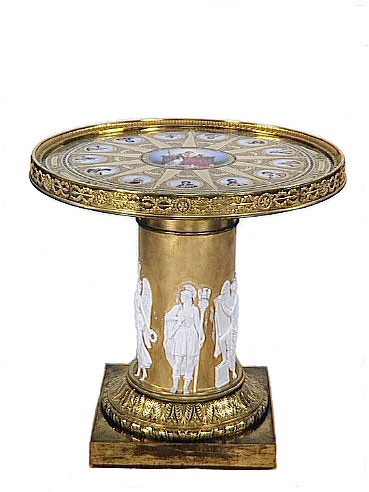
This formal piece of furniture progaganda made in memory of the famous victory at Austerlitz, the Austerlitz Table, was commissioned by Napoleon in 1806. Vivant Denon promised the emperor a «colossus in porcelain». Made over the period 1808 to 1810, this masterpiece from the Sèvres Manufactory was created by a 'dream team' of artists of the Empire period. Percier gave the general design, Gérard made that for the reliefs on the pedestal, Isabey painted the portraits for the top, and Thomire was put in charge of the bronzes.
The pedestal in the form of a short column is decorated with victories bearing symbols of war, and the top is a solar disc (the famous 'sun of Austerlitz') glorifying the victors. The central medallion bears Napoleon enthroned wearing his coronation robes, and from this emerge thirteen rays within which are inscribed the principal victories of the campaign. Between the rays stand the portraits of eleven marshals and two Grands Officiers de la Maison de l'Empereur, all with their noble titles: Murat (Joachim-Napoléon), King of the Two Sicilies; Augereau, Duc de Castiglione; Soult, Duc de Dalmatie; Mortier, Duc de Trévise; Davout, Duc d'Auerstaedt; Marmont, Duc de Raguse; Caulaincourt, Duc de Vicence, Grand Ecuyer; Duroc, Duc de Frioul, Grand Maréchal du Palais; Bessières, Duc d'Istries; Ney, Duc d'Elchingen; Lannes, Duc de Montebello; Bernadotte, Prince de Ponto-Corvo; and Berthier, Prince and et Duc de Neufchâtel.
Delivered in 1811, the Austerlitz Table was placed, ironically, in the Empress Marie-Louise's salon in the Tuileries Palace. It did however travel briefly in 1812 to the Salon of 1812 as evidence of the mastery of the Imperial Manufactory at Sèvres. Exhibited under the name of Isabey, the Austerlitz Table was positioned by Vivant Denon near to another table, this one showing Alexander surrounded by twelve heroes from antiquity, also commissioned by the Emperor from the Sèvres manufactory. During the Restoration, the work was sold by Louis XVIII and after passing through many hands was bought in 1929 the Musée de Malmaison at the auction of the Prince de la Moskowa, a descendant of Maréchal Ney.
Karine Huguenaud (tr. P.H.)
January 2003
The Austerlitz or ‘Maréchaux’ Table
- Date :
- 1808-1810
- Technique :
- biscuit, porcelain and gilt bronze
- Place held :
- Rueil-Malmaison, Musée national des châteaux de Malmaison et de Bois-Préau
- Photo credit :
- © RMN