

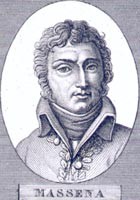
Fact file
Born Nice, 6 May, 1758, died Paris, 4 April, 1817
Married Mlle Lamarre
Cabin boy 1771 – 1775
Volunteer in the Royal-Italian regiment up to the rank of adjutant sous-officier, retired 1789
Moved to Antibes
Soldier in the Var, Adjudant-major in 1789 to Adjudant-général 1792
Served in the Armée d’Italie, 1792-1798
Brigadier general August 1793
Fought with Lapoype at the seige of Toulon,14 December 1793
Commander of the right wing under Dumerbion, 2 January 1794
Confirmed as ‘Général de Division’ by the Comité de Salut Public, 29 August, 1794
Fought at Melogno, Loano, Montenotte, Dego, Cherasco, Lodi, Lonato, Castiglione,
Peschiera, Bassano, Due Castelli, Saint-Georges, Brenta, Caldiero, Arcole, San
Michele, Rivoli and La Favorita (for which Bonaparte described him as ‘l’enfant chéri de la victoire’); Chiusa, Tarvisio, Neumarkt, Unzmarkt
Made commander of the 1st Division on the reorganisation of the Armée d’Italie, 14, June 1797
Nominated to the Armée d’Angleterre, 12 January, 1798
Commander of the troops detailed to occupy the Papal States, 3 February
He handed over command to Dallemagne as the result of a mutiny, 23-25 February
Recalled by the Directory, 8 March
Replaced by Gouvion-Saint-Cyr, see below
Appointed Commander of the Armée d’Helvétie, 9 December, 1798
Arrived in Zurich, 11 December and subordinated to Jourdan on the same day and again on 2 March, 1799
Fought at Coire (7 March), Feldkirch (22 March) and appointed provisory Commander in Chief of the combined Armées du Danube et Helvétie in place of Jourdan, taking command in Strasbourg 9 April, 1799
Victor at the Battle of Zurich over the combined Austrian and Russian forces, 25-26 September, 1799, forcing Suvorov who had crossed the St Gothard Pass into a disastrous retreat towards Coire
Victor at Andelfingen, 7 October
Replaced Championnet as Commander in chief of the Armée d’Italie, 23 November
Left the Armée d’Helvétie, established his Headquarters in Nice (17 January 1800) and then went to Genoa.
With his line of retreat through the Var cut off by the Austrians, and separated from Suchet and half of his army, he was encircled in Genoa, 5 April, 1800
Heroically endured the siege, the famine and the plague, until capitulation 4 June, ten days before Marengo – he was however allowed to leave Genoa and retire into the Var with full military honours and his troops intact.
Made Commander in chief of the combined Armées d’Italie et de la Réserve
Stepped down, 21 August and retired to Rueil with a pension of 30.000 francs, 23 September
Received a sabre of honour, 6 October
Député for the Seine department at the Corps Législatif, 28 July 1803 – 31 December 1807
Maréchal de l’Empire, 19 May 1804
Grand aigle and chef of the 14th cohort of the Légion d’Honneur, 2 February 1805
Replaced Jourdan as Commander in chief of the Armée d’Italie, 30 August 1805 and took command of the Armée de Milan on 6 September
Took Verona, 18 October, fought John VI at Caldiero, 30 October
Appointed Commander of the 8e corps of the Grande Armée, 11 December
Appointed Commander in chief of the Armée de Naples, 28 December and took command in Bologna on 9 January, 1806
Invaded the kingdom of Naples and took Capua, 12 February, 1806
Entered Naples with Joseph Bonaparte, 14 February and became Commander in chief of the Armée de Naples under Joseph, King of Naples, 21 February
Set siege to and took Gaeta, 26 February – 19 July
Left Naples to rejoin the Grande Armée, 12 January 1807, and took command of the 5e corps of the Grande Armée in place of Lannes, 24 February
Given leave of absence on health grounds, 15 July 1807, he returned to Rueil
Duc de Rivoli, 24 April, 1808
Commander of the Armée d’observation de l’armée du Rhin (subsequently, the 4e corps de l’Armée d’Allemagne), 23 February 1809
Distinguished himself at Landshut (11 April), Eckmühl (22 April), Straubing (23 April), Passau (26 April), and Ebersberg (3 May)
Glorious role at the Battle of Essling, defending Aspern and covering the retreat, 22 May
Commanded the left wing of the army at the Battle of Wagram, 4-6 July
Received the full Austrian attack, 6 July
Came to the aid of Marmont at Znaïm, 11 July
Authorised to return to France – made Prince d’Essling, 31 January, 1810
Made commander of the Armée de Portugal, 17 April, arriving in Valladolid to take up his post, 10 May
Took Ciudad-Rodrigo 10 July and Almeida 28 August
Beaten by Wellington at Busaco, 27 September
Drove the English back behind the line of Torrès-Vedras, but unable to enforce the blockade, October 1810 to March 1811
Beat a retreat to the French border, 6 March 1811
Fought the inconclusive Battle of Fuentes de Onoro, 3 and 5, 1811
Removed from office by the Emperor, recalled to France and replaced by Marmont, 7 May, 1811
Governor of the 8e Division militaire de Toulon, 16 April, 1813
Did not make active attempts to stop Napoleon on his ‘vol de l’aigle’ at the beginning of the ‘Hundred Days’
Made Pair de France, 2 June, 1815
Commander in chief of the Garde Nationale Parisienne, 22 June – 8 July, 1815
Governor of Paris, 3 July, 1815 – replaced on the return of the Bourbons
Died in 1817
Buried with full military honours in Père-Lachaise cemetery, his name appears on the Arc de Triomphe
Further reading
Marshall-Cornwall, J., Marshal Massena, London; New York: Oxford University Press, 1965 (translated as Masséna – L’enfant chéri de la Victoire, Paris: Plon, 1967)
Horward, D. D., The Battle of Busaco, Massena vs. Wellington, Tallahassee: Florida State University, 1965