

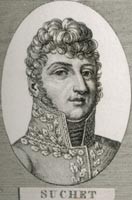
Born Lyons, 2 March, 1770, died Marseilles, 3 January, 1826.
Married Honorine Antoine de Saint-Joseph (her mother was Marie-Anne-Rose Marseille-Clary, sister-in-law of Joseph Bonaparte) in 1808
Elected lieutenant colonel en chef of the 4e bataillon de volontaires de l’Ardèche, 20 September 1793
Captured British general O’Hara at the siege of Toulon, December 1793
In the Armée d’Italie 1794-97, fought at Dego, Cossaria, Lodi, Borghetto, Castiglione, Bassano, Cerea, Saint-Georges, (under Masséna) Arcole, Neumarkt
Brune’s chief of staff in Switzerland, Feburary-March 1798
Général de Brigade, 23 March, 1798
Chief of staff in Armée d’Italie 22 August, 1798
Deprived of his office on refusing to take up his appointment as chief of staff for the Armée d’Helvétie, December 1798
Joubert’s General Chief of Staff, July 1799 (fought at the Battle of Novi, taking over command on Joubert’s death)
Interim commander of the Armée d’Italie in place of Championnet, 31 December 1799 to 5 January 1800
Commander of the Left Wing of the the Armée d’Italie under Masséna, 8 January, 1800
Cut off from Masséna during the retreat, 8 April, 1800
Failed in his attack on Monte San Giacomo, 19 April, 1800
Driven back from Loano, 1 May, 1800
Retreated to the river Var, a bridgehead over which he held, 22 and 26 May, 1800
Occupied Genova on 22 June, 1800; commander of the centre of the Armée d’Italie (divisions Boudet and Gazan) under Masséna and under Brune (divisions Loison and Gazan), September 1800
Took Volta (21 December) and fought at Pozzolo (25 December)
Governor of Padua, January 1801
General inspector of the infantry, 24 July 1801
Comandant of the 4e corps of the Grande Armée under Soult, 26 August, 1805 – this became the 3rd division of the 5e corps of the Grande Armeé under Lannes, 10 October, 1805
Fought at Ulm, Hollabrunn and Austerlitz, 2 December, 1805
Grand aigle of the Légion d’Honneur, 8 February, 1806
Fought at Saalfeld (10 October), Iéna (14 October), Pultusk (26 December), and Ostrolenka (16 February, 1807)
Commander of the 1er division of the 5e Corps under Masséna, 24 February, 1807
Provisional commander of the 5e Corps of the Grande Armée in Silesia, August 1807
Chevalier of the Couronne de Fer
Commandeur of the Ordre de Saint-Henri de Saxe
Comte de l’Empire, 19 March 1808
Commander of the 1er division of the 5e Corps under Mortier in the Armée de l’Espagne, 2 October, 1808
Fought at the siege of Saragossa (December 1808)
Commandant (in place of Junot) of the 3e Corps of the Armée de l’Espagne (which became the Armée d’Aragon), 5 April, 1809
Beaten back by Blake at the Battle of Alcanitz, 23 May, 1809
Victory over Blake at Maria (15 June), Belchite (18 June), the Bridge of Alventosa (January 1810)
Occupied Segorbe (3 March), failed at Valencia (March), siege and taking of Lerida (30 April – 14 May), siege and taking of Mequinenza (20 May – 8 June), siege and taking of Tortoza (June 1810 – 2 January, 1811), siege and taking of Taragona (4 May – 28 June 1811)
Maréchal de France, 8 July, 1811
Took Monserrat, 24 July, occupied Murviedro (27 September), victory over Blake at Puebla de Benaguasil (1 October), took the fort of Oropesa (11 October), victory at Sagonte (25 October – wounded in the shoulder by a bullet), took the fort of Sagonte (26 October), blockaded Valencia (26 October), received the town’s capitulation 10 January, 1812
Duc de Albufera, 24 January, 1812
Took the fort of Peniscola (4 February), beaten at Castalla (13 april 1813), raised the siege of Taragona (12 June), evacuated Valencia (July 1813)
Commander in chief of the Armées de Catalogne et d’Aragon, April 1813
Raised once again the siege of Taragona, 15 August, 1813
Governor of Catalonia, 15 November
Colonel general of the Imperial Guard in place of Bessières, 18 November 1813
Victory at Molinas del Rey (15 January 1814), evacuated Catalonia (April 1814)
Commander in chief of the Armée du Midi, 22 April, 1814
Pair de France, 4 June, 1814
Governor of the 14e division militaire à Caen, 21 June, 1814
Commandeur de Saint-Louis, 24 September, 1814
Governor of the 5e division militaire à Strasbourg, 30 November, 1814
Commandant of the 5e Corps d’observation in Strasbourg, 26 March, 1815
Sent to Lyons as commandant supérieur of the 6e, 7e, 8e, 9e, et 19e division militaires, 4 April, 1815
Commandant en chef of the 7e Corps d’observation (Armée des Alpes), 26 April, 1815
Pair de France, 2 June, 1815
Invaded Savoy, l2 June, 1815 and evacuated the country, 30 June, 1815
Agreed a convention in Lyons with Austrians for the evacuation to the town, 12 July, 1815
Struck off the list of Pairs de France during the Second Restauration
Removed by Louis XVIII from being governor of the 5e division militaire, 27 December, 1815
Again nominated Pair de France, 5 March, 1819
Born into a wealthy silk-making family, Suchet had a remarkably successful military career, particularly in Spain. Like Miollis, he was briefly governor of a department in French Italy, in this case Padouan or il Padovano (the area around Padua). Unlike the other Maréchals whom Napoleon harshly criticised on Saint Helena, Suchet never lost Napoleon’s high esteem (despite serving militarily during the first Restoration).
Further reading
Bergeron, B., Le Maréchal Suchet, 1986
Rousseau, F., La carrière de Maréchal Suchet, Paris: Didot, s.d. (but pre-1899)
Suchet, L.-G., Mémoires, Paris: Didot, 1828